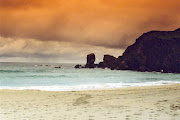
Communion services were (and still are) held throughout Lewis during 3 or 4 day gatherings in district churches,with many services and many visiting ministers in attendance. Communion would be offered at special services to all communicants during these days. There was a "season" during the year when "na h-orduighean" were in full swing throughout the island. People would travel long distances,often on foot,to attend communions in distant villages. This was the case with the two young ladies from Bernera who were making their way to "Orduighean Siabost" (Shawbost Communions). Darkness was falling as they made their way through Carloway,and they knew that they would not make Shawbost by nightfall,especially as they were now pretty fatigued. One of the ladies remarked that they had relatives in Dalmore - Maclennans, originally from Bernera. She was sure that they would find a bed there for the night. At this juncture,it should be pointed out(and there's no delicate way of relating this) that one of the ladies had an excessive amount of dark facial hair, on her upper lip and around her chin. They made their way to "taigh Shoudie",and Murdo answered the rap at the door. The ladies stated their business and said who they were. Ushering them into the house,Murdo said "Father,there's a girl and a young boy here to see us,relatives of ours from Bernera. They were made very welcome, given something to eat,and the conversation centred on their kith and kin back in Bernera. Gradually,Murdo realised that a great mistake had been made,and addressing his father Shoudie, he said "Father,it's not a boy and a girl at all,but two young women from Bernera". Well, Bodach Shoudie had to think fast. "Bless me,bless me, but my eyesight is not what it used to be,and the smoke in here can get so bad at times, that sometimes I call Mary,the Merak and at other times I think that the Merak is Mary.
N.B. Mary was his wife. As for "the Merak" - I've no idea who or what she was.It was exactly as I heard it! The ladies went on their way the next day,hopefully none the worse for meeting new found relatives.
Dalmore Daytime

Sandy Beach
Friday, 12 September 2008

Wednesday, 10 September 2008
Shoudie. His Exceptional Strength.
My paternal grandfather, Alexander Maclennan came from Garenin,the son of Murdo Maclennan, from Bosta on the island of Bernera,and known as "Murchaidh Drobhair" (his people had been cattle drovers). He married a Garenin girl,Mary Maclennan(b,1826),known as "Mairi Alasdair",and Murdo came courting his true love by rowboat across the salty waters of Loch Roag(weather permitting). This is not the case of consanguinity it might seem. Although all these Maclennans came originally from Bernera(Bosta/Kirkibost),Mary's people came to Garenin by way of a couple of generations' stay in Tolsta a'Chaolais. So,we have a Maclennan married to a Maclennan,albeit involving a slight separation of a couple of generations. Mary had a younger sister,Catherine(b.1837),who for some years(c.1860)was maid in the manse on St.Kilda,the "island on the edge of the world". When she returned home to Garenin,she was known as "Mairi Hirta". Hirta is the Gaelic name for St.Kilda. Mairi Hirta was my grandfather Maclennan's aunt,and it is he,"Shoudie",that is the subject of this letter. I've no idea how he came to be called "Shoudie",but I do know of two other Maclennans, also known as Shoudie,one living in Shawbost,and another in Point. Strange,wouldn't you say?
My grandfather had worked in one of the Glasgow shipyards for a time,and while there,had sustained multiple fractures to one of his legs,when a heavy steel plate fell on him from a gantry above. The way his fractures were set left Shoudie unable to straighten that leg for the rest of his days. It seems that in his youth, Shoudie had a "set-to" with a very powerfully built tinker from Stornoway called Seamus Drummond. A great many years later Drummond called at Shoudie's house to repair or sell tin utensils,and was invited in,not knowing whose house it was. Drummond,peering through the smoke,saw a man wearing a bonnet, at the upper end of the "being"(bench)lying stretched out with one leg bent,touching the clay floor,the other stiff and straight, resting along the bench."Shoudie,is that you,man? Is this truly the man I tussled with all those years ago?" I'm sure that they had much to talk about.Shoudie was not "big-made" but he was known for the exceptional strength in his arms and wrists. One day in Garenin,a group of young men were involved in a "contest" of strength to see who could lift a cart's axle,with the two large wheels attached. They all had various attempts,but no one could raise the wheels above the grass. An older man who had witnessed this trial of strength saw Shoudie come "hirpling" in the road,and baiting the youths,said that the man approaching could do what none of them had managed. They laughed at this and accepted the man's wager of a pouch of tobacco(Shoudie smoked a pipe). The man pointed to the cartwheel and axle,and told Shoudie "there's a poke of tobacco in this if you can lift that lot off the ground". Shoudie took up position and,with one hand,raised the "competition piece" clean off the ground.
Corrections.
1.My stupid error. It was Mary Maclennan's sister Catherine(Catriona),who had been maid to the minister in St.Kilda(Hirta),and on her return to Garenin was thereafter known as "Catriona Hirt"
2.I recently bought Calum Ferguson's exceptional book,"St.Kildan Heritage" (Acair 2006),and it was there I learned some information that was important to me,but would be the cause of this second error.
In Calum Ferguson's book,amongst a great deal of factual information on St.Kilda,he includes the 1891 census,which is of course the official Government Census initiated in 1841 to cover every part of Britain.
In House No.1(ie.the Manse), we have
Fiddes,Angus(48)-minister
MacLennan,Catherine(43)-servant
Chisnell,Jessie(45)-nurse.
Assuming the accuracy of the census details,if Catherine MacLennan was aged 43 years in 1891,then she must have been born in 1848,and not 1837 as in my blog. Again,she could not have been a maid to the minister in c.1860,being then only 12 years old.
Although my dates were a bit awry,I did know that my ancestor,Catriona Hirta was in St.Kilda "away back then" as maid to the minister. But her name is absent from the 1901 Census! For me it places Catherine in a different era,and persuades me to find out a bit more about her time on Hirta.
My grandfather had worked in one of the Glasgow shipyards for a time,and while there,had sustained multiple fractures to one of his legs,when a heavy steel plate fell on him from a gantry above. The way his fractures were set left Shoudie unable to straighten that leg for the rest of his days. It seems that in his youth, Shoudie had a "set-to" with a very powerfully built tinker from Stornoway called Seamus Drummond. A great many years later Drummond called at Shoudie's house to repair or sell tin utensils,and was invited in,not knowing whose house it was. Drummond,peering through the smoke,saw a man wearing a bonnet, at the upper end of the "being"(bench)lying stretched out with one leg bent,touching the clay floor,the other stiff and straight, resting along the bench."Shoudie,is that you,man? Is this truly the man I tussled with all those years ago?" I'm sure that they had much to talk about.Shoudie was not "big-made" but he was known for the exceptional strength in his arms and wrists. One day in Garenin,a group of young men were involved in a "contest" of strength to see who could lift a cart's axle,with the two large wheels attached. They all had various attempts,but no one could raise the wheels above the grass. An older man who had witnessed this trial of strength saw Shoudie come "hirpling" in the road,and baiting the youths,said that the man approaching could do what none of them had managed. They laughed at this and accepted the man's wager of a pouch of tobacco(Shoudie smoked a pipe). The man pointed to the cartwheel and axle,and told Shoudie "there's a poke of tobacco in this if you can lift that lot off the ground". Shoudie took up position and,with one hand,raised the "competition piece" clean off the ground.
Corrections.
1.My stupid error. It was Mary Maclennan's sister Catherine(Catriona),who had been maid to the minister in St.Kilda(Hirta),and on her return to Garenin was thereafter known as "Catriona Hirt"
2.I recently bought Calum Ferguson's exceptional book,"St.Kildan Heritage" (Acair 2006),and it was there I learned some information that was important to me,but would be the cause of this second error.
In Calum Ferguson's book,amongst a great deal of factual information on St.Kilda,he includes the 1891 census,which is of course the official Government Census initiated in 1841 to cover every part of Britain.
In House No.1(ie.the Manse), we have
Fiddes,Angus(48)-minister
MacLennan,Catherine(43)-servant
Chisnell,Jessie(45)-nurse.
Assuming the accuracy of the census details,if Catherine MacLennan was aged 43 years in 1891,then she must have been born in 1848,and not 1837 as in my blog. Again,she could not have been a maid to the minister in c.1860,being then only 12 years old.
Although my dates were a bit awry,I did know that my ancestor,Catriona Hirta was in St.Kilda "away back then" as maid to the minister. But her name is absent from the 1901 Census! For me it places Catherine in a different era,and persuades me to find out a bit more about her time on Hirta.
Sunday, 7 September 2008
Sheepdog Trials. One Man and his Dog.
When I was a young lad in the early 1950s,the Lewis sheepdog came in all 57 varieties(it seemed to me),which might loosely be referred to as the "West Highland" sheepdog. Whether these dogs ever existed as a true breed,I don't know,but what I do know is that they were highly skilled in the tasks demanded of them. I believe they were better at sheep gathering and fetching on the wide expanses of the Lewis moors,than at close quarter work on the croft.There were exceptions,of course. The Shoudie dog,Julia(aka Stowlia or Dolita)was always impressed to see a large flock of sheep being brought towards the fank by two or three of her fellow canines. Stowlia would,at this late stage,join in the fun,running back and forward just like the class-act dogs,her tail wagging furiously at the kudos of being seen as a real sheepdog. She was just great! Even back then,certain men were recognised for their prowess with their sheepdogs,and their pups were always in demand by others.
In no time at all,sheepdog trials became very popular on Lewis,and contestants became increasingly high-profile in competitions which demanded great skills from both man and dog. Competition was keen at these trials,and in many cases, frankly, fierce. It was at this time that crofters began to import sheepdogs from the mainland,dogs of proven ability and known pedigree. They were almost entirely of the breed known as the "border collie",which originated in the Scottish borders,and which were the stars of the big UK trialing scene. They were small,very fast and highly intelligent. Usually black, with some patches of white,they were expensive to buy and this usually entailed the Lewisman going out to the mainland to assess the pup and its mother. All the serious trialists on Lewis and Harris bought into the border collie,and spent long hours training their dogs to obey their commands,using voice,whistle and who knows,what else.
Norman Macarthur(Tiger Navarre)stayed at the end of the Dalmore road,just inside the Carloway fence. If you knew "Tiger",you knew how appropriate was this name. "Navarre", his father,I assume was given that name because of his presence in France during World War One. Tiger,the brother-in law of Seoras(George,8 Dalmore),was already known as being good with a sheepdog,at that time,a large brown and black dog called Toss. Tiger went over to the border collies,and from that time (c.1955)he emerged as possibly the top sheepdog trialist in all Lewis and Harris. I was often in Tiger's house, as I knew Alex(Alexina)his wife from her days living in Dalmore. Alex was a kind woman,with a fine sense of humour. I remember one day going over to the dogs in their outside kennel with some some bread or potatoes,when I was stopped in my tracks by Tiger shouting at me "Don't go near the dogs.I am the one who feeds these dogs.and only me"
We would attend trials in Shawbost,Lochs and Barvas in George's Austin A.35 van,and often returned with a 1st.prize and a silver cup. The one to win was the Stornoway Sheepdog Trials,held each year in the Castle Grounds. Tiger did not get it all his own way,as at this time, there was a very worthy opponent in the Stornoway butcher,'An Bhragie.If anyone were capable of denting Tiger's crown,it would be 'An Bhragie. Often, these two would be well ahead of the field. I remember one Stornoway trials(1956/1957), when we went across in the A.35 van with Tiger and his dog,and Ia'Ruadh Dhomhnull Higort(Garenin),who felt like mixing it with the big boys. 'An Bhragie was there as expected and performed to his usual high standard. I don't remember how the points were scored in these trials,but I do recall parts of the trials viz. outrun,shedding,penning. Tiger won that year,and the Cup was Dalmore bound. A lot of whisky went into, and out of, that large silver trophy in the following few days.
I have not been to sheepdog trials in a very long time,and I would not be surprised to discover that they now employ satellite navigation and radio controlled collars.
In no time at all,sheepdog trials became very popular on Lewis,and contestants became increasingly high-profile in competitions which demanded great skills from both man and dog. Competition was keen at these trials,and in many cases, frankly, fierce. It was at this time that crofters began to import sheepdogs from the mainland,dogs of proven ability and known pedigree. They were almost entirely of the breed known as the "border collie",which originated in the Scottish borders,and which were the stars of the big UK trialing scene. They were small,very fast and highly intelligent. Usually black, with some patches of white,they were expensive to buy and this usually entailed the Lewisman going out to the mainland to assess the pup and its mother. All the serious trialists on Lewis and Harris bought into the border collie,and spent long hours training their dogs to obey their commands,using voice,whistle and who knows,what else.
Norman Macarthur(Tiger Navarre)stayed at the end of the Dalmore road,just inside the Carloway fence. If you knew "Tiger",you knew how appropriate was this name. "Navarre", his father,I assume was given that name because of his presence in France during World War One. Tiger,the brother-in law of Seoras(George,8 Dalmore),was already known as being good with a sheepdog,at that time,a large brown and black dog called Toss. Tiger went over to the border collies,and from that time (c.1955)he emerged as possibly the top sheepdog trialist in all Lewis and Harris. I was often in Tiger's house, as I knew Alex(Alexina)his wife from her days living in Dalmore. Alex was a kind woman,with a fine sense of humour. I remember one day going over to the dogs in their outside kennel with some some bread or potatoes,when I was stopped in my tracks by Tiger shouting at me "Don't go near the dogs.I am the one who feeds these dogs.and only me"
We would attend trials in Shawbost,Lochs and Barvas in George's Austin A.35 van,and often returned with a 1st.prize and a silver cup. The one to win was the Stornoway Sheepdog Trials,held each year in the Castle Grounds. Tiger did not get it all his own way,as at this time, there was a very worthy opponent in the Stornoway butcher,'An Bhragie.If anyone were capable of denting Tiger's crown,it would be 'An Bhragie. Often, these two would be well ahead of the field. I remember one Stornoway trials(1956/1957), when we went across in the A.35 van with Tiger and his dog,and Ia'Ruadh Dhomhnull Higort(Garenin),who felt like mixing it with the big boys. 'An Bhragie was there as expected and performed to his usual high standard. I don't remember how the points were scored in these trials,but I do recall parts of the trials viz. outrun,shedding,penning. Tiger won that year,and the Cup was Dalmore bound. A lot of whisky went into, and out of, that large silver trophy in the following few days.
I have not been to sheepdog trials in a very long time,and I would not be surprised to discover that they now employ satellite navigation and radio controlled collars.
Wednesday, 27 August 2008
Fishing at "Bandaberie",Dalmore.
I have written about the Gearraidh in previous posts,that beautiful, green and fertile part of Dalmore,a land of old corn mills, and at times home to the "iolaire",the majestic golden eagle. It is,however,a place in which one never feels at ease, and I'm not sure why! The Gearraidh pushes out into the Atlantic Ocean in a promontory at "Rudha an Trileachain"(headland of the oyster catchers ),and how well named it is. The rocks here are strewn with the shells of mussels and limpets,but gey few oysters. You see,the bulk of the island's shellfish leaves for France and Spain in giant refrigerated lorries. "Round the corner" from this point and flanking the wild beach of "Sheilagadh"is a sea rock called "Bandaberie",a favoured plinth for sea fishing with the "slat"(bamboo rod),yielding good catches,but it is an exceedingly treacherous place. Not for nothing was "Bandaberie" feared by the women of Dalmore.
To access the site,you had to climb down a near vertical rock face(about 20 feet down),and carrying the "slat",that could be difficult. However,there were enough finger and toe holds to ease your descent. Strong sea currents swirled around the rock from which we fished,and the top of the rock was only inches above the sea. You always had to be mindful of those freak waves that crashed over the rock,and be prepared to abandon your position. These bamboo rods were 20-25 feet long,and a strong twine,tied at the top,ran down the length of the rod(no reel needed here). Attached to the end of the line was a cast of 6 or 7 flies made from large hooks and white seagull feathers. Cold boiled potato left over from the "tatties and herring" lunch would be squashed in the hand and this ground bait tossed into the clear waters of the "geotha". Within a few minutes,the long bamboo("slat")would be arching over with the great strain on the line,and you could see perhaps 6 or 7 fish down in the waters below. While in the water,this heavy catch was buoyed by the upthrust(Archimedes'Principle,you recall),but when the fish were pulled from the water,you had a seething mass of disparate forces acting in every direction,including up. The only thing that might be considered art, was landing every last fish on the rocks behind you. You then had to "dehook" every fish,and stick them in the brown hessian bag, On Bandaberie, it was rare to catch any fish except the "cuidaig"(cuddy/small saithe)or the"saighean"(saithe/coal fish). The only thing which limited your catch(or enthusiasm) was the knowledge that you had to get a heavy bag of fish up that near vertical cliff,and then transport it nearly a mile over hill and dale. Then,of course,the fish had to be gutted and washed.
These fresh fish, fried in the morning's bacon fat,and served with Stag bread and butter and a mug of tea, was a meal to savour. I wonder if anyone still fishes at Bandaberie,or knows how to get down there. I doubt it.
Domhnull Lamont and my uncle Norman(Tormod Glass)fished on Bandaberie a great deal,and installed a rope/wire ladder there, which afforded easier access to the site.
P.S. Tamra (U.S.A.) Thanks for your comment. D.J.Maclennan.
To access the site,you had to climb down a near vertical rock face(about 20 feet down),and carrying the "slat",that could be difficult. However,there were enough finger and toe holds to ease your descent. Strong sea currents swirled around the rock from which we fished,and the top of the rock was only inches above the sea. You always had to be mindful of those freak waves that crashed over the rock,and be prepared to abandon your position. These bamboo rods were 20-25 feet long,and a strong twine,tied at the top,ran down the length of the rod(no reel needed here). Attached to the end of the line was a cast of 6 or 7 flies made from large hooks and white seagull feathers. Cold boiled potato left over from the "tatties and herring" lunch would be squashed in the hand and this ground bait tossed into the clear waters of the "geotha". Within a few minutes,the long bamboo("slat")would be arching over with the great strain on the line,and you could see perhaps 6 or 7 fish down in the waters below. While in the water,this heavy catch was buoyed by the upthrust(Archimedes'Principle,you recall),but when the fish were pulled from the water,you had a seething mass of disparate forces acting in every direction,including up. The only thing that might be considered art, was landing every last fish on the rocks behind you. You then had to "dehook" every fish,and stick them in the brown hessian bag, On Bandaberie, it was rare to catch any fish except the "cuidaig"(cuddy/small saithe)or the"saighean"(saithe/coal fish). The only thing which limited your catch(or enthusiasm) was the knowledge that you had to get a heavy bag of fish up that near vertical cliff,and then transport it nearly a mile over hill and dale. Then,of course,the fish had to be gutted and washed.
These fresh fish, fried in the morning's bacon fat,and served with Stag bread and butter and a mug of tea, was a meal to savour. I wonder if anyone still fishes at Bandaberie,or knows how to get down there. I doubt it.
Domhnull Lamont and my uncle Norman(Tormod Glass)fished on Bandaberie a great deal,and installed a rope/wire ladder there, which afforded easier access to the site.
P.S. Tamra (U.S.A.) Thanks for your comment. D.J.Maclennan.
Sunday, 17 August 2008
Donald Macleod("Glass") Dies,Aged 92 years
It was a lovely April day and old "Bodach Glass" decided to take a gentle stroll,perhaps as far as the "traigh"(shore). His daughter Dollag agreed,exhorting him to be careful and to take his time.The old man set out across the "stairean"(path to house) with his "bata" in hand, Some time later in the afternoon,Domhnull Chalum had awakened after "forty winks" in his chair at No.8. He told his wife that he had a mind to take a walk into the shore. "O a'ghraidh,you have not been in there in years". "Well,I feel like taking a walk in there now", Donald replied. He was now in his late 80s,so each step was measured and taken slowly, down the road, past the cemetery and the "allt"(river) to the shore.
Anyone who knows Dalmore beach is aware of the large rounded stones situated half way along the traigh,where Allt Dhailamor empties into the sea. It was here, from a point above the river, that Domhnull Chalum discovered his old friend "Glass" lying prostrate on the stones. Donald set out back to the village to alert folk of the situation. Finding Glass on the stones,has given rise to two possible scenarios. The first of these is that Glass was making his way across the stones when his foot became trapped under some boulders. He was too weak to extricate his foot,and seeing the incoming tide approaching ever nearer,he feared he might drown and suffered a massive stroke. The second,and more probable scenario,is that he suffered a stroke and fell on the rocks. However it happened,a stroke was diagnosed by the doctor.
Villagers followed Shonnie with the horse and cart,which was lined with bales of hay,and Old Glass was removed from there to his own house at No.5 Dalmore. There in his bed,where I often heard him pray long and fervently to his Lord,Donald Macleod,my Grandpa, passed away peacefully on the 30th April,1953 aged 92 years.
Anyone who knows Dalmore beach is aware of the large rounded stones situated half way along the traigh,where Allt Dhailamor empties into the sea. It was here, from a point above the river, that Domhnull Chalum discovered his old friend "Glass" lying prostrate on the stones. Donald set out back to the village to alert folk of the situation. Finding Glass on the stones,has given rise to two possible scenarios. The first of these is that Glass was making his way across the stones when his foot became trapped under some boulders. He was too weak to extricate his foot,and seeing the incoming tide approaching ever nearer,he feared he might drown and suffered a massive stroke. The second,and more probable scenario,is that he suffered a stroke and fell on the rocks. However it happened,a stroke was diagnosed by the doctor.
Villagers followed Shonnie with the horse and cart,which was lined with bales of hay,and Old Glass was removed from there to his own house at No.5 Dalmore. There in his bed,where I often heard him pray long and fervently to his Lord,Donald Macleod,my Grandpa, passed away peacefully on the 30th April,1953 aged 92 years.
Friday, 15 August 2008
"Glass". A Fearless Old Bodach.
The two incidents related here,though small in themselves,demonstrates the fearlessness of my grandfather,"Glass",even at his advanced age. In fairness,he was a fairly fit old gentleman,albeit he now carried a walking stick to steady his gait.
Shonnie had gathered together some sheep in a small impromptu fank,high up on croft No.9 under Beinn Dhalamor. Shonnie was dealing with some sheep helped by one of my aunts. I was standing just outside the "gate" of the fank,beside my grandfather,when a ram leaped over the gate,and with its large horns,struck my grandad square on his chest. Old Glass fell back,but as the ram continued over him,he held out his "bata" and its crook locked with one of its horns.As the ram was subdued,I heard the bodach utter the word "salachar"(filth)
One afternoon,I was sitting with my grandpa Glass and his old pal Domhnull Chalum on some seats down by the roadside at No.8. Two or three of the younger men were in attendance. The gate for the village was out the road at No.10(we called it "geata na Cnamhean"),and should always have been kept closed to stop animals making their way into the rich machair pastures and the cemetery. The sound of "thunder" drew our attention to a cloud of dust out the road,and emerging out of this were the three village horses coming in the road at a full gallop. Someone had left the gate open and our equine friends were heading into the shore. Nobody moved, and seeing these three stallions bearing down on us,it seemed the sensible thing to do. But no one could have foreseen what happened next. Glass got up and shuffled out to the middle of the road,and shouting and waving his arms and bata about,like a man possessed,the horses took one look at this wild old bodach and came to a sudden halt.One of the younger men saw the horses out the road,and shut the gate. The generational gap was beginning to show, even back then.
Shonnie had gathered together some sheep in a small impromptu fank,high up on croft No.9 under Beinn Dhalamor. Shonnie was dealing with some sheep helped by one of my aunts. I was standing just outside the "gate" of the fank,beside my grandfather,when a ram leaped over the gate,and with its large horns,struck my grandad square on his chest. Old Glass fell back,but as the ram continued over him,he held out his "bata" and its crook locked with one of its horns.As the ram was subdued,I heard the bodach utter the word "salachar"(filth)
One afternoon,I was sitting with my grandpa Glass and his old pal Domhnull Chalum on some seats down by the roadside at No.8. Two or three of the younger men were in attendance. The gate for the village was out the road at No.10(we called it "geata na Cnamhean"),and should always have been kept closed to stop animals making their way into the rich machair pastures and the cemetery. The sound of "thunder" drew our attention to a cloud of dust out the road,and emerging out of this were the three village horses coming in the road at a full gallop. Someone had left the gate open and our equine friends were heading into the shore. Nobody moved, and seeing these three stallions bearing down on us,it seemed the sensible thing to do. But no one could have foreseen what happened next. Glass got up and shuffled out to the middle of the road,and shouting and waving his arms and bata about,like a man possessed,the horses took one look at this wild old bodach and came to a sudden halt.One of the younger men saw the horses out the road,and shut the gate. The generational gap was beginning to show, even back then.
Wednesday, 13 August 2008
"Glass" buys the Premier House Clock.
On the only visit "Glass",my grandfather,made to Renfrew(that I'm aware of),he was staying in Hairst(harvest)Street with his married daughter Kate,my aunt.This was around the early 1930s. Kate's tenement house was directly opposite Ross's Premier House,which was a large two-storey furniture store,also selling household "fancy goods". Bodach Glass was on the look out for a quality wall clock to take back to Dalmore. Glass knew that the Premier House had a good selection of clocks for sale, and finally paid a visit to their shop across the road. He was confronted by a large selection of clocks of all types and sizes,but almost immediately he knew of the one he wanted. This was a fine half-size case clock in dark hardwood,which chimed the hour and the half hour. It had an elegant,yet simple face and the pendulum lay behind a door of wood and bevelled glass. The salesman endeavoured to interest him in other clocks,but every time Glass made it plain that his mind was made up. "I'm sorry,sir but that clock is not for sale. You see,sir,that is the shop's clock". No matter,Glass told him that it was that clock,or none at all. Consultations followed,and one might have heard the manager say "A sale is a sale". Glass was very proud of his clock and on the way back to Lewis by train and boat,he carried it, held firmly on his lap(with the pendulum removed). As stated elsewhere,only the bodach saw to "his" clock in Dalmore,which he wound once a week,always on the same day. This clock is still keeping time and chiming away on the kitchen wall at No.7 Dalmore. The care taken by Glass with his clock to an extent mirrors the great care his wife Mary took in carrying her sewing machine from Garenin to Dalmore.
Tuesday, 12 August 2008
My Mother is Employed by Madam at the Club.
My mother,Anna Glass,was born in Garenin in 1911,the youngest of a family of nine children. When she was 12 years old,she went with her family to their new croft in Dalmore,but a large part of her heart was left behind in Garenin,which she would freely admit. Like most girls of that ilk and time,she followed the herring fleets from Lerwick to Lowestoft, but earlier had worked as a maid in Taigh a'Bhaicair in Carloway,which also involved her helping out in the shop,adjacent to the Baker's house. In the early 1930s,my mother left for Glasgow to seek employment there,in service, like thousands of fine girls from the Highlands and Islands. It was during this time that a friend of hers from Lewis,told my mother of the grand position she had in the New Club,a gentleman's club located in Glasgow's city centre. This was the foremost and most exclusive club in Glasgow,the equal of any in London. It had in its membership the top lawyers and industrialists,people like Sir Peter Coats of the thread family, the two Weir brothers(Weirs of Cathcart) and R.W.Forsyth the Glasgow retailers. My mother went for a job at the New Club,and was seen by a Miss Dick,who was in overall charge, managing the club, and who had her own suite of rooms within the building. She was the daughter of a doctor in Burghead near Inverness,and with her background, was suited to her position of looking after such fine gentlemen. She was known by club members and staff alike as "Madam". My mother was taken on as a waitress,and working there at the New Club,was like working at Buckingham Palace,but with nicer people. She shared the good news with her older sister Kate,married and living in Renfrew. She wrote a letter to her mother and father back in Dalmore,extolling the grandeur of the club,and the kindness of "Madam". Bodach Glass had not been further than Peterhead,but the words "club" and "madam" had an unwholesome ring to them. It was not,they agreed,a place for their Annie to work in,no matter how grand she found it. A letter expressing their concerns was dispatched to my mother in Glasgow forthwith. It took a visit by my Auntie Kate to the New Club,and a long letter from Miss Dick(no mention was made of "madam") before Old Glass and Mairi Ruadh were satisfied that their youngest daughter was not employed in a house of ill-repute.
Monday, 11 August 2008
Glass,Radio Luxemburg and a Barrel of Whisky.
I was 12 year old when "Glass" died,but still have vivid memories of him. I have recounted previously that I always slept behind the bodach "up in the room",that I was privy to his long prayers to God,that he "took the book" every night without exception and that he closely resembled the King's father,King George V.
His people had remained with the established church(Church of Scotland)at the Disruption which took place back in 1843, giving rise to the Free Church, which the vast majority of Lewis people joined. I remember my grandfather,Glass, dressing for church,three piece black suit,white shirt,black tie,highly polished boots and fob watch and chain across his middle. The last thing before leaving was to stand in front of mirror by the room door,and gently comb the royal white beard. He had been an elder of his church in Carloway for many years,and strangely he had a doppelganger there in the Carloway church, in the person of the Carloway Postmaster,"Am Post Mhor". They really were alike,elders of their church and men of a certain standing. The "Eaglais Saor" lacked the gravitas of such men.
I think that Glass might have been termed a liberal of the Church,but in truth, most people outwith the Free Church were looked upon as such, adhering to some dangerous heresies of the "distant past". Glass,you'll remember,allowed us city boys to listen to Radio Luxemburg's "Top Twenty" at 11.00 pm on a Sunday night. "O mo gradh ort". Unlike "Shoudie", my other grandfather, Glass neither smoked nor drank(ie.alcohol)but saw no reason to denounce others who did. During the war, Glass found a barrel of whisky bobbing about on the surf on Dalmore beach. There was no need to worry the hard pressed customs' men,so Glass had the barrel removed to his barn by horse and cart, under the watchful eye of a couple of interested old friends in the village. "Dhe a'seo",they must have wondered. Well,they would discover shortly. Glass would invite Shoudie and Domhnull Chalum over to No.5 each day after lunch(except Sunday,of course - he wasn't that much of a liberal). Glass would excuse himself and head for the "sobhal",where the "uisge beatha" was secreted under the hay,draw off two good measures and return to his pals,who never once made a comment,but they did wonder about Glass's way with water and whisky. The conversations these afternoons were highly enjoyable and at times frivolous,despite the war and its privations. Shoudie must have hoped that Glass could change a few dockin leaves into tobacco! These afternoon get-togethers would last quite a while - well,until the barrel ran dry.
His people had remained with the established church(Church of Scotland)at the Disruption which took place back in 1843, giving rise to the Free Church, which the vast majority of Lewis people joined. I remember my grandfather,Glass, dressing for church,three piece black suit,white shirt,black tie,highly polished boots and fob watch and chain across his middle. The last thing before leaving was to stand in front of mirror by the room door,and gently comb the royal white beard. He had been an elder of his church in Carloway for many years,and strangely he had a doppelganger there in the Carloway church, in the person of the Carloway Postmaster,"Am Post Mhor". They really were alike,elders of their church and men of a certain standing. The "Eaglais Saor" lacked the gravitas of such men.
I think that Glass might have been termed a liberal of the Church,but in truth, most people outwith the Free Church were looked upon as such, adhering to some dangerous heresies of the "distant past". Glass,you'll remember,allowed us city boys to listen to Radio Luxemburg's "Top Twenty" at 11.00 pm on a Sunday night. "O mo gradh ort". Unlike "Shoudie", my other grandfather, Glass neither smoked nor drank(ie.alcohol)but saw no reason to denounce others who did. During the war, Glass found a barrel of whisky bobbing about on the surf on Dalmore beach. There was no need to worry the hard pressed customs' men,so Glass had the barrel removed to his barn by horse and cart, under the watchful eye of a couple of interested old friends in the village. "Dhe a'seo",they must have wondered. Well,they would discover shortly. Glass would invite Shoudie and Domhnull Chalum over to No.5 each day after lunch(except Sunday,of course - he wasn't that much of a liberal). Glass would excuse himself and head for the "sobhal",where the "uisge beatha" was secreted under the hay,draw off two good measures and return to his pals,who never once made a comment,but they did wonder about Glass's way with water and whisky. The conversations these afternoons were highly enjoyable and at times frivolous,despite the war and its privations. Shoudie must have hoped that Glass could change a few dockin leaves into tobacco! These afternoon get-togethers would last quite a while - well,until the barrel ran dry.
Sunday, 10 August 2008
Mairi Ruadh and Miss Darling of Stornoway
Glass's wife was Mary Macneil(Mairi Dhomhnaill Fhionnlaigh),but she was always known as "Mairi Ruadh" (Red haired Mary). Born in Garenin like her husband,my grandmother came over to Dalmore when she was 50 years old, to take charge of a new home in a new village,without the support of her kith and kin in Garenin. She died in 1940,aged 69,so that anything I know of her was gleaned from the stories told to me by mother,aunts and others who knew her well. Mairi Ruadh was a woman of strong character,an imposing figure who had the love and respect of her family. She had the fine looks and hair colour of the Macneils. As a young lass,she was in service at a manse in Tarbert,Harris before marrying Glass at the young age of 19 years. As we have seen,Mary prepared wool for weavers in Garenin,including her husband. Her most prized possession in her home was an early model Singer sewing machine and with this she could run up men's trousers,jackets and a variety of ladies apparel. Mary was well known in the district for her prowess at sewing,and many were the favours she did for other people. When,in 1923,the family's goods and chattels were being moved by road to their new home in Dalmore,Mary was so afraid that her sewing machine would be damaged in the cart,that she carried the machine,strapped to her back,the 3 miles over the hills to Dalmore. That was some feat, which shows how much she valued her Singer sewing machine.
The following story involves my grandmother in the late 1920s,and in a strange way it has a resonance in the present. By about 1927, Mairi Ruadh had her new home to her liking,and her youngest Annie(Anna Glass,aged 16)had captured the heart of Alasdair Shoudie the "best looking lad in the whole district"(her very words to me). Even back then,Dalmore,and especially the beach,proved a great attraction to visitors, and in particular two people who came quite often to Dalmore in a "horse and gig" all the way over from Stornoway. These were "duine uasail"(toffs,if you will)as their clothes would attest. The lady wore a beautiful coat,trimmed with fur,a fur hat and expensive shoes.Her gentleman friend wore plus fours and brogues and his bonnet matched his jacket. In case one might think this to be fiction,we have photographs taken by the "duine uasail's" own camera - no one in Dalmore had a camera in 1927! One afternoon in late summer,our family were down at the "feannaig"(strip field) beside the road making stooks of the corn,when these two people stopped to chat. Mairi Ruadh invited them over to the house for a "copan the",and maybe some scones and pancakes. It transpired that the lady was a Miss Darling,who taught at Stornoway Primary School. After that, she and the man in plus fours often stopped off at 5 Dalmore to visit Mairi Ruadh and sample the very best home baking this side of Stornoway.
Now fast forward from 1927 to around 1994,and there was I, parked at the ferry terminal at Uig in Skye,waiting for the "Hebrides" to transport me to Lewis(via Harris,of course). A family pulled up in their car abreast of me,and the driver was immediately recognisable(white hair and jet black bushy eyebrows) as that able young Labour MP for Edinburgh Central,Alistair Darling. It was some time later,thinking of that name "Darling" that I made the connection between that man in the car and Miss Darling of 1927. She was possibly the Chancellor of the Exchequer's great aunt.
If the Chancellor gets wind of my blog,then maybe he will invite me to No.11 for scones and pancakes. And when he holidays in Lewis,as he often does,and he takes his family to Dalmore,he might want to glance across at the ruin at No.5,where two fine ladies,the Miss Darling and the Mistress Macleod once took tea together.
The following story involves my grandmother in the late 1920s,and in a strange way it has a resonance in the present. By about 1927, Mairi Ruadh had her new home to her liking,and her youngest Annie(Anna Glass,aged 16)had captured the heart of Alasdair Shoudie the "best looking lad in the whole district"(her very words to me). Even back then,Dalmore,and especially the beach,proved a great attraction to visitors, and in particular two people who came quite often to Dalmore in a "horse and gig" all the way over from Stornoway. These were "duine uasail"(toffs,if you will)as their clothes would attest. The lady wore a beautiful coat,trimmed with fur,a fur hat and expensive shoes.Her gentleman friend wore plus fours and brogues and his bonnet matched his jacket. In case one might think this to be fiction,we have photographs taken by the "duine uasail's" own camera - no one in Dalmore had a camera in 1927! One afternoon in late summer,our family were down at the "feannaig"(strip field) beside the road making stooks of the corn,when these two people stopped to chat. Mairi Ruadh invited them over to the house for a "copan the",and maybe some scones and pancakes. It transpired that the lady was a Miss Darling,who taught at Stornoway Primary School. After that, she and the man in plus fours often stopped off at 5 Dalmore to visit Mairi Ruadh and sample the very best home baking this side of Stornoway.
Now fast forward from 1927 to around 1994,and there was I, parked at the ferry terminal at Uig in Skye,waiting for the "Hebrides" to transport me to Lewis(via Harris,of course). A family pulled up in their car abreast of me,and the driver was immediately recognisable(white hair and jet black bushy eyebrows) as that able young Labour MP for Edinburgh Central,Alistair Darling. It was some time later,thinking of that name "Darling" that I made the connection between that man in the car and Miss Darling of 1927. She was possibly the Chancellor of the Exchequer's great aunt.
If the Chancellor gets wind of my blog,then maybe he will invite me to No.11 for scones and pancakes. And when he holidays in Lewis,as he often does,and he takes his family to Dalmore,he might want to glance across at the ruin at No.5,where two fine ladies,the Miss Darling and the Mistress Macleod once took tea together.
Saturday, 9 August 2008
" Glass". Crofter,Weaver and Fisherman.
Glass,my grandfather,was an industrious man,who never let the grass grow under his feet. He was a great provider for his family,and in that regard,he was willing to turn his hand to many different jobs. In the first place he was a crofter on the five acres at 5 Dalmore, and happy he must have been to rent this croft here in the "Dailean",which recently had been Padruig Sinclair's sheep farm. He was also a weaver,weaving tweed on a wooden hand loom,which I can remember was stored in the "sobhal" (barn) at No.5, possibly hoping to be ressurected, if that new fankled iron loom proved a failure. Alas,alas old friend! These tweeds were made into blankets by his wife Mary,who was in business(in a small way) with a friend, Catherine Macleod,when they were still in Garenin.From time to time,Glass wove tweeds for the mills in Stornoway. He was reckoned to be a fine weaver in these days.
Glass was also a fisherman on one of the local sailing boats of the "Carloway Fleet",based at the Dunan. He was a crew member of the 21 ton "Press Home",owned by his cousin "Gherry" (Duncan Macleod). This was in the years 1880-1890,when there were 26 boats fishing all year round, out of Loch Carloway. Later,Glass would own his own boat,"The Plover" (SY 571),around 1890. At other times,he followed the fishing season over on the east coast of Scotland with Shoudie's brother, " Domhnull Drobhair" (Donald Maclennan,9 Garenin). These two men were lifelong friends. These sail boats operated 3 miles out to sea, and used the large line,each line bearing 1,000 hooks,baited with eel(sometimes halibut!).They were after ling which was a highly prized fish back in these days. A common daily return for these boats might be 500/600 ling and they were sold for 7 or 8 pence(old money)each. The ling had to measure 2 and a half feet,"eye to tail" or failing that, 2 ling for one.
I was told the following story about Glass,"eithear Gherry" and a colossal catch of ling,which occurred in the distant past. It seems that Glass ,with a crew of 5 or 6 in "eithear Gherry"(Gherry's boat)went out very early one morning to fish for ling using the large lines,and according to the storyteller,they struck gold almost immediately. The boat was up to the gunwales(or is it rowlocks)in an abundance of ling. They got their catch to the market just as it opened,and their catch commanded a record price for those times. Glass suggested that if they all put their shares of the money together,they would be in a position to buy the boat from the owner,Gherry,if he was in agreement. He was,and the ownership transferred to "Glass & Co". Well that's the story,and maybe that's how the "Press Home" became "The Plover" - maybe!
Glass was also a fisherman on one of the local sailing boats of the "Carloway Fleet",based at the Dunan. He was a crew member of the 21 ton "Press Home",owned by his cousin "Gherry" (Duncan Macleod). This was in the years 1880-1890,when there were 26 boats fishing all year round, out of Loch Carloway. Later,Glass would own his own boat,"The Plover" (SY 571),around 1890. At other times,he followed the fishing season over on the east coast of Scotland with Shoudie's brother, " Domhnull Drobhair" (Donald Maclennan,9 Garenin). These two men were lifelong friends. These sail boats operated 3 miles out to sea, and used the large line,each line bearing 1,000 hooks,baited with eel(sometimes halibut!).They were after ling which was a highly prized fish back in these days. A common daily return for these boats might be 500/600 ling and they were sold for 7 or 8 pence(old money)each. The ling had to measure 2 and a half feet,"eye to tail" or failing that, 2 ling for one.
I was told the following story about Glass,"eithear Gherry" and a colossal catch of ling,which occurred in the distant past. It seems that Glass ,with a crew of 5 or 6 in "eithear Gherry"(Gherry's boat)went out very early one morning to fish for ling using the large lines,and according to the storyteller,they struck gold almost immediately. The boat was up to the gunwales(or is it rowlocks)in an abundance of ling. They got their catch to the market just as it opened,and their catch commanded a record price for those times. Glass suggested that if they all put their shares of the money together,they would be in a position to buy the boat from the owner,Gherry,if he was in agreement. He was,and the ownership transferred to "Glass & Co". Well that's the story,and maybe that's how the "Press Home" became "The Plover" - maybe!
Friday, 8 August 2008
"Glass" and his wife "Mairi Ruadh".
As mentioned elsewhere,my grandfather,Donald Macleod ("Glass"),was born in Garenin in 1860, and was one of the Macleods whose ancestors first settled in the Sithean,the small hamlet below the present Garenin road. Garenin grew into a sizable village,with "Macleod" the predominant surname. In 1890,Glass,a young man of 30 years,married his sweetheart,Mary Macneil,aged just 19, who stayed out the road at No.14. She had striking red hair, and because of this my grandmother was always known as "Mairi Ruadh". Their first marital home was in the small building which today houses the "laundry" in the Garenin Thatched Village. In 1904 he moved to Croft No.4 where he had built a house on a relative's croft(his father,Norman's,I think).This is "Taigh Glass",No.4A,one of the thatched houses which today can be rented from the Garenin Trust. As we have seen in earlier postings,Glass acquired the newly created croft at No.5 Dalmore in 1920,and the whole family moved there in 1923. Dalmore was just a couple of miles up the coast,which was just as well as many of the children(my mother told me) were very homesick for Garenin,and were always making return visits there to see their cousins and friends. Two of Glass's nine children never lived to see the home in Dalmore,his son Donald who died in Holland in 1916 during WWI(see earlier postings),and Christina who died from tuberculosis in 1912,aged only 19 years. My mother said that "Cairistiona" was a very Christian girl,and that in the last week before she died in December,she wakened once and said to her mother that she would dearly love a piece of fresh fish, "A'Ghraidh,this is the middle of winter,and there are no boats out",said her mother. "God will provide,I am sure",replied Cairistiona. Her brother Norman,then aged 9,was out on the moor behind Garenin when he saw a strange thing indeed. There in a peat bog,jumping and flapping about,was a good sized sole,which could only have been transported there by some seabird,whose bill was unable to hold on to the "leabag" before Norman lifted it. Every one was amazed at what happened,except Christina.
Glass was 60 when he moved to Dalmore and 63 before he saw his house built and his wife and children settled there. How many nowadays could start a new life, at what is at present an age to retire. They don't make them like "Glass" and "Mairi Ruadh" anymore,and they have not done so for a very long time,I think.
Glass was 60 when he moved to Dalmore and 63 before he saw his house built and his wife and children settled there. How many nowadays could start a new life, at what is at present an age to retire. They don't make them like "Glass" and "Mairi Ruadh" anymore,and they have not done so for a very long time,I think.
Wednesday, 6 August 2008
Clann 'ic Iain. "Long" and "Glass"
My maternal grandfather, Donald Macleod,was known as "Glass",and this monicker.if ever understood,was forgotten in the mists of time. But, he would always be known as "Glass",somewhat neater than his "sloinneadh" in Gaelic, "Domhnall Thormoid 'an 'ic Iain". "Sloinneadh" means surname in English, but it conveys a lot more information than the anglicised surname "Macleod",which is a clan name shared by hundreds of thousands of people the world over. However this simple lineage explains Glass's "slionneadh" in Gaelic,of course.
Iain(John Macleod b.~1760)--> Mac Iain(John Macleod b.~1790)--> Tormod 'an 'ic Iain(Norman Macleod b.1824)--> Domhnall Thormoid 'an 'ic Iain(Donald Macleod b.1860 ie.GLASS).
Iain Shoudie,a Maclennan uncle,and a nonsense rhymster,used to sing a little ditty to me as a young boy, which made some allusion to a physical characteristic inherited from my Macleod side.The last line of the ditty was
"Ha sron clann 'ic Iain air an Dhada". Whatever he observed,I (Dada)could see nothing peculiar about my nose.
I remember when (in 1951)I was 10 years old being taken to see the only other survivor of Glass's siblings,his brother Duncan,known as "Long",who was on his death bed in his old style black house at No.18 Gearrannan.This was a very old design of "taigh dubh",with the long axis of the house perpendicular to the hill and following its slope downhill. There was only one door which was used by people and animals alike,and the interior was "open plan". There was no "tallan" to separate man and beast. Just inside the door on the right was the well supplied by a spring.I don't know if this was unusual in a house of this vintage ie. first find yourself a spring and then build your house around it! There were no windows at all,and the fire burned in the middle of the rough clay floor.There was a gap in the thatch above the fire,which allowed some of the smoke out, and a small amount of daylight in,by which one could just see "Long".I do remember some people around his bed who were probably close relatives like my mother,one of many nieces("Long" and his wife,Catherine,had no children of their own). There was a cupboard and a few chairs, and the box bed on which "Long" was lying. At the lower end of the house was a large amount of cow manure,which would have been cleared out in spring, if Duncan had been a fit man. My abiding memory of "Taigh Long" was one of great poverty,and yet, many people who lived in these black houses reared large families and lived to a good age. "Long" lived all of 89 years,and his brother Glass died a year later in 1953,aged 92 years - poor in some things,rich in the things that matter.
Iain(John Macleod b.~1760)--> Mac Iain(John Macleod b.~1790)--> Tormod 'an 'ic Iain(Norman Macleod b.1824)--> Domhnall Thormoid 'an 'ic Iain(Donald Macleod b.1860 ie.GLASS).
Iain Shoudie,a Maclennan uncle,and a nonsense rhymster,used to sing a little ditty to me as a young boy, which made some allusion to a physical characteristic inherited from my Macleod side.The last line of the ditty was
"Ha sron clann 'ic Iain air an Dhada". Whatever he observed,I (Dada)could see nothing peculiar about my nose.
I remember when (in 1951)I was 10 years old being taken to see the only other survivor of Glass's siblings,his brother Duncan,known as "Long",who was on his death bed in his old style black house at No.18 Gearrannan.This was a very old design of "taigh dubh",with the long axis of the house perpendicular to the hill and following its slope downhill. There was only one door which was used by people and animals alike,and the interior was "open plan". There was no "tallan" to separate man and beast. Just inside the door on the right was the well supplied by a spring.I don't know if this was unusual in a house of this vintage ie. first find yourself a spring and then build your house around it! There were no windows at all,and the fire burned in the middle of the rough clay floor.There was a gap in the thatch above the fire,which allowed some of the smoke out, and a small amount of daylight in,by which one could just see "Long".I do remember some people around his bed who were probably close relatives like my mother,one of many nieces("Long" and his wife,Catherine,had no children of their own). There was a cupboard and a few chairs, and the box bed on which "Long" was lying. At the lower end of the house was a large amount of cow manure,which would have been cleared out in spring, if Duncan had been a fit man. My abiding memory of "Taigh Long" was one of great poverty,and yet, many people who lived in these black houses reared large families and lived to a good age. "Long" lived all of 89 years,and his brother Glass died a year later in 1953,aged 92 years - poor in some things,rich in the things that matter.
Wednesday, 30 July 2008
R.A.F. Uig Crash Land In Carloway
There were some fine teams and fine players in Lewis at that time,and particularly so "re na samhraidh a bhalaich Goill" (ie.during the summers of the Lowland boys). These lads brought their own skills to the Lewis game,which meant that no one could be sure of the outcome of a game, as few realised the calibre of these "new signings",nor from whence they came. They played throughout the year in a very competitive and often punishing arena. Their close season would allow them the luxury of playing during Lewis'"summer season".
A game which is still remembered,and which is probably the finest ever on Lewis soil, took place around 1958 in Carloway,between Carloway and the RAF team from Uig, where the RAF then had a sizable base. Today Aird Uig, with the remains of that camp, has an eerie quality about it,and in some ways reminds me of the location for "The Wicker Man". Being a services' team,they wanted for nothing,and were immaculately turned out and well supported. What became apparent later was that over half the RAF team were signed players with various English sides(Divisions 2,3 and 4). Carloway could boast Donald Maclennan(Renfrew Juniors) and the "Pralan" twins,Murdo and Duncan from Upper Carloway,who both played for Ardrossan Winton Rovers at that time.Seen for the first time,certainly by me,were the binovular twins of Anna Gherchy, two lads called Donnie and Ronnie Mackinnon(father was from Skye,you see)who took to the field that evening. I must say that they they looked the part, and their recent slim history was impressive. They had recently played for Dunipace Juniors and Rutherglen Glencairn and had been signed by top Scottish clubs,Donnie by Partick Thistle and his twin brother,Ronnie by Glasgow Rangers. In the first half,RAF proved to be the professionals, of which we were unaware,and led 2-0 at the interval. As bad as the result was,continuing taunts of "Come on Carloway,show us your style!"began to exercise the sizable home support. Every English accent from Newcastle to the Thames estuary were arrainged in belittling the Carloway boys.
Murdo Mackay ("The Bear")was the team's manager by dint of having bought the orange juice and the plastic pail. He pulled Donald,my brother aside,and in not so many words,asked what the hell was going on. "Don't worry,A' Mhurchadh,we'll take six off them". In Glasgow,such a statement is one of hope over promise. Whatever was said or agreed among the Carloway team,the crowd witnessed a brilliant display of football,probably never repeated again on the island.Ronnie Mackinnon moved up to the centre of the forward line,Donnie remained in midfield,and Donald my brother had a roving commission down the right flank.The idea was to feed Ronnie down the middle,and being the consumate professional,he scored five brilliant goals fed to him mainly by my brother,who scored himself to make the final score Carloway 6, RAF Uig 2."We'll take six off them". Maybe a wee bit of a prophecy.What do you think?
During the second half,the Sassenach support were beginning to get a tad tired of my cousin,Aonghas Hearradh, continuing to cry "Come on RAF Uig,show us your style!"
A game which is still remembered,and which is probably the finest ever on Lewis soil, took place around 1958 in Carloway,between Carloway and the RAF team from Uig, where the RAF then had a sizable base. Today Aird Uig, with the remains of that camp, has an eerie quality about it,and in some ways reminds me of the location for "The Wicker Man". Being a services' team,they wanted for nothing,and were immaculately turned out and well supported. What became apparent later was that over half the RAF team were signed players with various English sides(Divisions 2,3 and 4). Carloway could boast Donald Maclennan(Renfrew Juniors) and the "Pralan" twins,Murdo and Duncan from Upper Carloway,who both played for Ardrossan Winton Rovers at that time.Seen for the first time,certainly by me,were the binovular twins of Anna Gherchy, two lads called Donnie and Ronnie Mackinnon(father was from Skye,you see)who took to the field that evening. I must say that they they looked the part, and their recent slim history was impressive. They had recently played for Dunipace Juniors and Rutherglen Glencairn and had been signed by top Scottish clubs,Donnie by Partick Thistle and his twin brother,Ronnie by Glasgow Rangers. In the first half,RAF proved to be the professionals, of which we were unaware,and led 2-0 at the interval. As bad as the result was,continuing taunts of "Come on Carloway,show us your style!"began to exercise the sizable home support. Every English accent from Newcastle to the Thames estuary were arrainged in belittling the Carloway boys.
Murdo Mackay ("The Bear")was the team's manager by dint of having bought the orange juice and the plastic pail. He pulled Donald,my brother aside,and in not so many words,asked what the hell was going on. "Don't worry,A' Mhurchadh,we'll take six off them". In Glasgow,such a statement is one of hope over promise. Whatever was said or agreed among the Carloway team,the crowd witnessed a brilliant display of football,probably never repeated again on the island.Ronnie Mackinnon moved up to the centre of the forward line,Donnie remained in midfield,and Donald my brother had a roving commission down the right flank.The idea was to feed Ronnie down the middle,and being the consumate professional,he scored five brilliant goals fed to him mainly by my brother,who scored himself to make the final score Carloway 6, RAF Uig 2."We'll take six off them". Maybe a wee bit of a prophecy.What do you think?
During the second half,the Sassenach support were beginning to get a tad tired of my cousin,Aonghas Hearradh, continuing to cry "Come on RAF Uig,show us your style!"
Monday, 28 July 2008
The Stornoway Cup Final (Around 1956)
In the months of July and August each year,football on the island of Lewis was trasformeed by the arrival of scores of young proto Leodhaisich who were "home" on their fortnight's fair holiday. They came from all parts of mainland Scotland and there were even some from England and the USA. Foreign holidays were almost unknown to us in the 1950s, and the arrival of so many young men and women to the island in the space of a few weeks, recalled the days when these islands were rightly known as "Tir nan Oig" (The Land of the Young ). The Glasgow Fair fortnight was by far the busiest time,when the island was "jumping" with dances,"cattle shows",busy bothans,something called "ruith nan oidhche"(which never was explained to me!)and of course a packed programme of football fixtures. Young men who regularly played football on the mainland,at amateur,secondary juvenile and junior levels,converged on Lewis to pull on the strips of their host villages,albeit for a couple of weeks. The game was thus transformed the length and breadth of the island during these summer weeks. In some small way,it is similar to the influx of foreign players to the Scottish League nowadays. When my brother,Donald, arrived in Stornoway at the beginning of the Glasgow Fair(second fortnight in July),"officials" of Carloway F.C. were standing at the bottom of the ship's gangway to sign Donald as a Carloway player for the duration. At least once,they paid his fare from Glasgow for an important game, a day or two outwith the Fair holiday. Of course every team would sign up 2 or 3 "visitors",and no game would play out as one might have expected, in the days before the arrival of this windfall of football talent.
And so it was that Domhnull Glass and a couple of fellow professionals turned out for Carloway against Stornoway United in the final of the Stornoway Cup at Goathill Park (1956?). United were the top team in these days,and were loath to surrender "their town's cup" to a bunch of Siarachs.They were so determined to win this game that they flew two of their top players from Inverness to Stornoway,at the club's expense.Few ordinary people could afford the high cost of a plane journey. The two United stars were "Raleigh" and "Blake"( nicknames,of course ),and these lads were working on the mainland. No expense would be spared in bringing these men over for this cup final. I can not think of the names "Raleigh" and "Blake", without picturing two Royal Naval destroyers viz. "HMS Raleigh" and "HMS Blake" coming to wreak havoc on this wee boat from Carloway. The result was United 1, Carloway 5 and to say that this was unbelievable is close to the truth. Donald's performance was outstanding, and this galvanised his fellow team mates to secure one of the biggest upsets in Lewis football history. There was a large dance later that evening in the Stornoway Town Hall, at which the cup was presented to a euphoric Carloway team and its 3 supporters.
We often say that it's a small world,and sometimes we can't believe just how small!
Last Sunday,while in the middle of writing this post ,I and three friends went on a fast boat trip from Seil Island to Iona. The young lady assisting,after some discussion about seals,found out that I had Lewis connections in Dalmore. "My mother is a Maciver from North Shawbost" exclaimed Liz,and she then mentioned that her uncle was known as "Larry". "Is that the same Larry who played football for Carloway when my brother was there? I am right in saying that he was a handsome cove,with beautiful Brylcreemed hair,and a good player to boot?" Liz said that this was the same Larry, and to him I extend my very best wishes(Iain Alasdair Shoudie).
And to the beautiful little ecologist,Liz I thank you for making my trip to Iona so interesting. By the way,Liz,when you laugh your face lights up,just like Larry's.
And so it was that Domhnull Glass and a couple of fellow professionals turned out for Carloway against Stornoway United in the final of the Stornoway Cup at Goathill Park (1956?). United were the top team in these days,and were loath to surrender "their town's cup" to a bunch of Siarachs.They were so determined to win this game that they flew two of their top players from Inverness to Stornoway,at the club's expense.Few ordinary people could afford the high cost of a plane journey. The two United stars were "Raleigh" and "Blake"( nicknames,of course ),and these lads were working on the mainland. No expense would be spared in bringing these men over for this cup final. I can not think of the names "Raleigh" and "Blake", without picturing two Royal Naval destroyers viz. "HMS Raleigh" and "HMS Blake" coming to wreak havoc on this wee boat from Carloway. The result was United 1, Carloway 5 and to say that this was unbelievable is close to the truth. Donald's performance was outstanding, and this galvanised his fellow team mates to secure one of the biggest upsets in Lewis football history. There was a large dance later that evening in the Stornoway Town Hall, at which the cup was presented to a euphoric Carloway team and its 3 supporters.
We often say that it's a small world,and sometimes we can't believe just how small!
Last Sunday,while in the middle of writing this post ,I and three friends went on a fast boat trip from Seil Island to Iona. The young lady assisting,after some discussion about seals,found out that I had Lewis connections in Dalmore. "My mother is a Maciver from North Shawbost" exclaimed Liz,and she then mentioned that her uncle was known as "Larry". "Is that the same Larry who played football for Carloway when my brother was there? I am right in saying that he was a handsome cove,with beautiful Brylcreemed hair,and a good player to boot?" Liz said that this was the same Larry, and to him I extend my very best wishes(Iain Alasdair Shoudie).
And to the beautiful little ecologist,Liz I thank you for making my trip to Iona so interesting. By the way,Liz,when you laugh your face lights up,just like Larry's.
Friday, 25 July 2008
Stornoway and the "Deedle Doddle".
I have to say that, when I was younger,I found Stornoway to be an interesting place,and at times,even exciting. It was of course a town,a Royal Burgh indeed,and increasingly cosmopolitan. There were people from Mallaig,Buckie,Inverness and a few Sassenaich in highly placed positions,with of course the Italians in the cafes and the itinerant Asian gentlemen with their large brown cases of clothing and haberdashery.
Some people had long since left their rural idyll for life in the town,in search of a job,a home and in some cases marriage and a family. Living in the city,you felt that it went on and on in all directions,whereas with Stornoway, you could define its limits - it had grown gradually around the harbour area over some time, in an easy and attractive way . Later,probably under Mathieson, Stornoway was rebuilt as a "model town" with its rectangular grid of streets. You couldn't lose yourself in Stornoway,unless your sat-nav was compromised by a few "halfs". Our reasons for "going across" to Stornoway were varied,and almost always pleasurable. Carloway Football Club played the different Stornoway teams at Goathill Park,and with 3 or 4 teams sharing that football pitch ( United,Athletic,Rovers and School? ),we were over in Stornoway many a night. Sheep dog trials in the Castle Grounds would also see us "in town". The mink farm required us to visit the slaughterhouse and the Broad Bay fish shop in Stornoway once a week for animal offal and fresh fish carcasses. I will return again to expand on "the mink" and the sheep dog trials.
My brother,Donald ,was a gifted football player and showed promise from an early age(primary school and secondary school teams). I remember that our Aunty Peigi took a great interest in Donald's career. When money was tight,after the war,she sent money to our mother(her sister)to buy Donald his first pair of football boots,and on another occasion a leather football.There was no Nike nor Adidas in 1948 ( perhaps the young Fritz Walter had heard of them ),but these boots were made entirely from a lightly tanned cow hide,and that included leather studs and leather boot laces. The boots had steel toe caps,presumably to allow one to "toe end" a long kick without the boot imploding. The toes,after a few games,pointed upwards and this could be useful in "punting the ball into the middle". The leather studs were hammered into the sole of the boot,which often resulted in the protruding nails piercing the soles of the foot. The leather football had an inner rubber tube (bladder) which was pushed through an opening in the leather panels. The bladder was inflated to the right pressure,the connector tied with string and the "tubey" laced up,boy's style.It was inevitable,that during a game, the lacing would ease a bit and stand proud of the ball. If one were to head this "tubey",the chances were that,more so on a wet day, your forehead was left with a nasty grase or worse. Goodness knows where this football gear was made,but it was the same for Willie Waddell,Billy Steel or "Bustling" Billy Houliston.Donald had this "state of the art" gear,but the difference was that the professionals were paid £5 per game. Coming up - The Stornoway Cup Final: United v Carloway,at Goathill Park around the year 1956?
Some people had long since left their rural idyll for life in the town,in search of a job,a home and in some cases marriage and a family. Living in the city,you felt that it went on and on in all directions,whereas with Stornoway, you could define its limits - it had grown gradually around the harbour area over some time, in an easy and attractive way . Later,probably under Mathieson, Stornoway was rebuilt as a "model town" with its rectangular grid of streets. You couldn't lose yourself in Stornoway,unless your sat-nav was compromised by a few "halfs". Our reasons for "going across" to Stornoway were varied,and almost always pleasurable. Carloway Football Club played the different Stornoway teams at Goathill Park,and with 3 or 4 teams sharing that football pitch ( United,Athletic,Rovers and School? ),we were over in Stornoway many a night. Sheep dog trials in the Castle Grounds would also see us "in town". The mink farm required us to visit the slaughterhouse and the Broad Bay fish shop in Stornoway once a week for animal offal and fresh fish carcasses. I will return again to expand on "the mink" and the sheep dog trials.
My brother,Donald ,was a gifted football player and showed promise from an early age(primary school and secondary school teams). I remember that our Aunty Peigi took a great interest in Donald's career. When money was tight,after the war,she sent money to our mother(her sister)to buy Donald his first pair of football boots,and on another occasion a leather football.There was no Nike nor Adidas in 1948 ( perhaps the young Fritz Walter had heard of them ),but these boots were made entirely from a lightly tanned cow hide,and that included leather studs and leather boot laces. The boots had steel toe caps,presumably to allow one to "toe end" a long kick without the boot imploding. The toes,after a few games,pointed upwards and this could be useful in "punting the ball into the middle". The leather studs were hammered into the sole of the boot,which often resulted in the protruding nails piercing the soles of the foot. The leather football had an inner rubber tube (bladder) which was pushed through an opening in the leather panels. The bladder was inflated to the right pressure,the connector tied with string and the "tubey" laced up,boy's style.It was inevitable,that during a game, the lacing would ease a bit and stand proud of the ball. If one were to head this "tubey",the chances were that,more so on a wet day, your forehead was left with a nasty grase or worse. Goodness knows where this football gear was made,but it was the same for Willie Waddell,Billy Steel or "Bustling" Billy Houliston.Donald had this "state of the art" gear,but the difference was that the professionals were paid £5 per game. Coming up - The Stornoway Cup Final: United v Carloway,at Goathill Park around the year 1956?
Monday, 21 July 2008
Princes,Pictures and" Pogan"
There often was a reason for going to Stornoway. When we were young boys,we went with an adult, who would generally have some "business" there. Later on,as times changed,and we changed,we did not need a reason "to go to town".
I remember going over to town with my uncle Shonnie on his motorbike(I think it was 1956)to see the royal family,who were on a tour of the Western Isles aboard the Royal Yacht "Britannia". It wasn't that we were fervent royalists,it was just that like so many others, we were "making our way to Stornoway" to witness an event which doesn't come around too often. Actually,about 25/30 years later,I was the sole reception committee to greet Prince Charles who was aboard a large Wessex helicopter, as it hovered above the Callanish Stones.I think Charles had an appointment in Uig,and it was deemed quicker "by air".I happened to be there(a favourite place of mine)when the whole of the prince's party appeared above me. The door slid open to afford the prince a better view of the mighty megaliths. I waved and he waved back - it was as simple as that,just being friendly. Shonnie and I were stationed at the corner of Cromwell Street and North Beach Street when the royal motorcade approached. It's ironic that here at "Buth Hamish"(James Mackenzie's shop on Cromwell Street),the Royalists met a Roundhead head on, once more.It was a warm summer's day,and Prince Philip drove the Queen very slowly past us in an open Hillman car,and near enough for me to notice the deep tan on them both,which had not been acquired on the present tour of the Hebrides. It has to be said that they made a handsome couple,looking happy and relaxed. The crowd cheered as they turned right up past Woolworths(can't do that now).Other cars followed, but the only other royal I can truly remember is HRH Princess Margaret Rose, as she passed us in an open Land Rover. She was a very beautiful young woman,and her beauty was said to eclipse that of any of the debutantes or society ladies of her day.
As my school returned later than others,I often made the return journey back to Renfrew on my own,which I found exciting. The "steamer" left Stornoway around midnight,and I made sure I was in town for early evening. I might have coffee and cake in the Rendezvous Cafe.I could afford to play the toff with the money I'd earned from the various enterprises in Dalmore. After that,it would almost certainly be a visit to the Picture House(I liked that name - no need for a grand name,it was the only cinema in town.) I distinctly remember two films from those times in the Picture House. There was the film "Marnie" with Jack Hawkins,and a film which made a lasting impression on me,"The Man Who Never Was",how British naval intelligence duped the Germans in WW2 by placing the body of a young British seaman in the Mediterranean Sea,carrying secret documents. Strangely, I saw this film not so long ago, and I enjoyed it just as much.
When I was 15(going 16),I had gone to my first Cattle Show Dance in the Carloway Drill Hall with Donald,my brother(17 going 18). I had been there a few times previously to see the offerings of the Highland and Islands Film Guild.But a dance there, with music from accordion and fiddle, and a whole lot of lovely girls was altogether different. My eye was taken by this lovely girl from Carloway,and later that morning (the dances started at midnight)I "saw her home". I think I got a couple of kisses from this bonnie lass. I was leaving Stornoway the following week,and we arranged to meet in town that afternoon.I remember she wore a shiny black mackintosh style coat,the belt tied in the "French style". We may have had coffee and cake,but surprisingly we did not go to the Picture House. I cannot be sure,but I think there were plenty more kisses that day.
Note : "pog s. - pogan pl." = kiss,kisses
I remember going over to town with my uncle Shonnie on his motorbike(I think it was 1956)to see the royal family,who were on a tour of the Western Isles aboard the Royal Yacht "Britannia". It wasn't that we were fervent royalists,it was just that like so many others, we were "making our way to Stornoway" to witness an event which doesn't come around too often. Actually,about 25/30 years later,I was the sole reception committee to greet Prince Charles who was aboard a large Wessex helicopter, as it hovered above the Callanish Stones.I think Charles had an appointment in Uig,and it was deemed quicker "by air".I happened to be there(a favourite place of mine)when the whole of the prince's party appeared above me. The door slid open to afford the prince a better view of the mighty megaliths. I waved and he waved back - it was as simple as that,just being friendly. Shonnie and I were stationed at the corner of Cromwell Street and North Beach Street when the royal motorcade approached. It's ironic that here at "Buth Hamish"(James Mackenzie's shop on Cromwell Street),the Royalists met a Roundhead head on, once more.It was a warm summer's day,and Prince Philip drove the Queen very slowly past us in an open Hillman car,and near enough for me to notice the deep tan on them both,which had not been acquired on the present tour of the Hebrides. It has to be said that they made a handsome couple,looking happy and relaxed. The crowd cheered as they turned right up past Woolworths(can't do that now).Other cars followed, but the only other royal I can truly remember is HRH Princess Margaret Rose, as she passed us in an open Land Rover. She was a very beautiful young woman,and her beauty was said to eclipse that of any of the debutantes or society ladies of her day.
As my school returned later than others,I often made the return journey back to Renfrew on my own,which I found exciting. The "steamer" left Stornoway around midnight,and I made sure I was in town for early evening. I might have coffee and cake in the Rendezvous Cafe.I could afford to play the toff with the money I'd earned from the various enterprises in Dalmore. After that,it would almost certainly be a visit to the Picture House(I liked that name - no need for a grand name,it was the only cinema in town.) I distinctly remember two films from those times in the Picture House. There was the film "Marnie" with Jack Hawkins,and a film which made a lasting impression on me,"The Man Who Never Was",how British naval intelligence duped the Germans in WW2 by placing the body of a young British seaman in the Mediterranean Sea,carrying secret documents. Strangely, I saw this film not so long ago, and I enjoyed it just as much.
When I was 15(going 16),I had gone to my first Cattle Show Dance in the Carloway Drill Hall with Donald,my brother(17 going 18). I had been there a few times previously to see the offerings of the Highland and Islands Film Guild.But a dance there, with music from accordion and fiddle, and a whole lot of lovely girls was altogether different. My eye was taken by this lovely girl from Carloway,and later that morning (the dances started at midnight)I "saw her home". I think I got a couple of kisses from this bonnie lass. I was leaving Stornoway the following week,and we arranged to meet in town that afternoon.I remember she wore a shiny black mackintosh style coat,the belt tied in the "French style". We may have had coffee and cake,but surprisingly we did not go to the Picture House. I cannot be sure,but I think there were plenty more kisses that day.
Note : "pog s. - pogan pl." = kiss,kisses
Sunday, 13 July 2008
Bobbins and Bluebottles.
Previously,I told of the "Big Jobs" which my Uncle Shonnie Glass allocated us at the beginning of each summer vacation. Taking home the peats by horse and cart and picking out the thistles from a field of cut hay, were just two examples of Shonnie's Big Jobs,ensuring continuity of work for us,throughout the vacation,and at the same time reinforcing the much vaunted presbyterian work ethic. This work ethic seemed to travel with the emigrant Scot,but mostly with the dour presbyterian ones,of which I suppose there were many. The Shoudie boys eschewed the work,making the ethic redundant. With them,there were no "big jobs",only those required to keep body and soul together(perhaps not even the "soul"). My Shoudie uncles never gave me a job to do,because they never had jobs to give. This was an ongoing ceilidh house,and no one would have had it any other way.
In my early teenage years,the two main "occupations" for me in Dalmore were the "bobbins" and the "minks",and the latter will be dealt with in full,later on.
Shonnie was a weaver of Harris Tweed,as were most men,and some women,in these days. A good weaver could earn a pretty decent wage,and many would later marry and set up home on the strength of the security offered by the "tweeds". Harris Tweed was always subject to the vagaries of fashion,and the strength or otherwise of the US dollar. At that time(1954-1959),the industry was booming,and weavers would get as many tweeds as they could manage. The mills which I remember were K.Mackenzie("Sticky),Newall and Smith,all of Stornoway and Kenneth Macleod of Shawbost(Coinneach Rodd). There may have been others,which I can't now recall. The woollen warp,coiled in a large hank,and the large bobbins of "snath" (thread)were dropped off at the roadside next to the croft at 5 Dalmore,and finished tweeds uplifted by the same mill lorry. I would watch Shonnie setting up the loom("beart") for the weaving of a tweed,which involved "beaming",sorting out hundreds of threads,and setting the shuttle box, whose rotations were obedient to the punched holes on metal "cards",similar to the Hollerith computer cards of that time. You can see that engineering and its attendant terminology passed me by. The only aspect of weaving which concerned me was "filling the bobbins",and it was a paid job to ensure that Shonnie always had "iteachan" for his "spalan"(ie. bobbins filled with thread for the shuttles). The "boban" machine was driven by that monster JAP petrol engine(you will recall!)and any decent boban man could fill a large wooden box of "iteachan" in a couple of hours,which would keep the weaver in harness for the rest of the day. The trick was to keep every spindle of the machine "occupied",and this came with some practice.The window by the bobbin machine had a ghoulish fascination for me,and it has to be said now,a source of entertainment, as I went about my business. This window was host to 3or4 spiders and the glass pane was a Spaghetti Junction of the finest of silk webs. There always were a great number of flies and bluebottles around,and there were many who were attracted to that window. When a bluebottle became enmeshed in a web,the noise of vibration was loud,as the poor insect tried to free itself. There was no escape as the spider shimmied out to mummify its prey in a silken sarcophagus. There were many skeletal remains dotted about these webs. By the way,I was paid five bob for a tweed's worth of bobbins. To this day,I associate the sound of a bluebottle with these days in the weaving shed,but now I usher them safely out the window.
PS. In the early 1960s,Mrs Perrins,owner of the Garynahine estate,was responsible for the launch of Ceemo Tweeds. She hired the "very best" weavers and designers to produce lightweight tweeds that would appeal to the couture markets of London and Paris. The Ceemo Tweed was exquisitely designed,very soft and light and a feature of these was the beautiful way that silver and gold Lurex was woven through the cloth. Ceemo was a brave attempt at bringing the "clo`mor" out of the past,to engage with a very sophisticated market. Ceemo did especially well in the fashion houses of Paris,but events were to see its demise,some years later.
In my early teenage years,the two main "occupations" for me in Dalmore were the "bobbins" and the "minks",and the latter will be dealt with in full,later on.
Shonnie was a weaver of Harris Tweed,as were most men,and some women,in these days. A good weaver could earn a pretty decent wage,and many would later marry and set up home on the strength of the security offered by the "tweeds". Harris Tweed was always subject to the vagaries of fashion,and the strength or otherwise of the US dollar. At that time(1954-1959),the industry was booming,and weavers would get as many tweeds as they could manage. The mills which I remember were K.Mackenzie("Sticky),Newall and Smith,all of Stornoway and Kenneth Macleod of Shawbost(Coinneach Rodd). There may have been others,which I can't now recall. The woollen warp,coiled in a large hank,and the large bobbins of "snath" (thread)were dropped off at the roadside next to the croft at 5 Dalmore,and finished tweeds uplifted by the same mill lorry. I would watch Shonnie setting up the loom("beart") for the weaving of a tweed,which involved "beaming",sorting out hundreds of threads,and setting the shuttle box, whose rotations were obedient to the punched holes on metal "cards",similar to the Hollerith computer cards of that time. You can see that engineering and its attendant terminology passed me by. The only aspect of weaving which concerned me was "filling the bobbins",and it was a paid job to ensure that Shonnie always had "iteachan" for his "spalan"(ie. bobbins filled with thread for the shuttles). The "boban" machine was driven by that monster JAP petrol engine(you will recall!)and any decent boban man could fill a large wooden box of "iteachan" in a couple of hours,which would keep the weaver in harness for the rest of the day. The trick was to keep every spindle of the machine "occupied",and this came with some practice.The window by the bobbin machine had a ghoulish fascination for me,and it has to be said now,a source of entertainment, as I went about my business. This window was host to 3or4 spiders and the glass pane was a Spaghetti Junction of the finest of silk webs. There always were a great number of flies and bluebottles around,and there were many who were attracted to that window. When a bluebottle became enmeshed in a web,the noise of vibration was loud,as the poor insect tried to free itself. There was no escape as the spider shimmied out to mummify its prey in a silken sarcophagus. There were many skeletal remains dotted about these webs. By the way,I was paid five bob for a tweed's worth of bobbins. To this day,I associate the sound of a bluebottle with these days in the weaving shed,but now I usher them safely out the window.
PS. In the early 1960s,Mrs Perrins,owner of the Garynahine estate,was responsible for the launch of Ceemo Tweeds. She hired the "very best" weavers and designers to produce lightweight tweeds that would appeal to the couture markets of London and Paris. The Ceemo Tweed was exquisitely designed,very soft and light and a feature of these was the beautiful way that silver and gold Lurex was woven through the cloth. Ceemo was a brave attempt at bringing the "clo`mor" out of the past,to engage with a very sophisticated market. Ceemo did especially well in the fashion houses of Paris,but events were to see its demise,some years later.
Saturday, 5 July 2008
Am Bhaile Mor. Steornabhadh Mhor a' "Chaisteil".
When I was very young,the only time I would see Stornoway("am bhaile mor" - the big village ie.the town),was in the coming and going, during our summer holiday on Lewis. Very few people had cars in the years after WW2. The local doctor would have a car,but ministers and midwives would,I think,have had to make do with a sturdy Raleigh bicycle. You would see vans and lorries in Dalmore,of course,but motor cars were rare visitors. An exception to this was the visitation to the cemetery in Dalmore of a steady flow of hearses for committal services in "Cladh Dhail a'Mor". So,when we saw a "car" coming in the Mullach Mor,it was generally a hearse taking the departed for "tiodhlacadh" (burial). As stated elsewhere,my older brother,Donald(born 17.12.38)stayed for his first four years at 5 Dalmore,with my Grandpa Glass and Aunts Peigi and Dollag,speaking only Gaelic(he never lost it).He eventually returned to Renfrew in preparation for starting primary school,and of course learning the "new" language of this strange and hectic place. Our house in Inchinnan Road overlooked the large roundabout at St.Andrew's Cross ,which was always busy with all forms of transport,including "real cars". Donald was looking out on this scene from the kitchen window,when he noticed my mother behind him. Like a wise wee man,with a slight shake of his head,he said in Gaelic,of course." Mother,what an awful lot of funerals there are in this place!"
I have one early memory(although vague)of "going over to Stornoway"(as we Siareachs would say),and that involved a visit to the Lewis Hospital. I know that it was nothing serious(Mother wasn't with us),but I do not recall which of us (Donald or me) needed medical attention,or whether one,other or both was detained there,but I don't think so. What I do remember is that the van was blue,and its owner/driver was "Calum Aonghas Alasdair",a close cousin of ours and a gentleman through and through.Calum was one of the few in the district who owned a vehicle,and who most certainly would have done this "mercy mission" for anyone who might have asked,whether related to Calum or not. On the way across to town,we sat in the front,as this, was the only part which had windows. I do remember that we went via Callanish,and that the roads were "morgnan"(gravel) until we reached the outskirts of Stornoway. It would be some years to come before tarmacadam(no abbreviation here - credit to the Scot) appeared in the rural areas of Lewis. I recall that when I walked along a stretch of "unmade" road ie.morgnan,it was surprisingly easy on my bare feet. At Achmore,the main road to Stornoway went straight ahead through "airidh" territory to meet up with the Pentland Road from Carloway.This was and still is the A.858 to Stornoway. The road to Leurbost via Cliasgro was a sheep track, for all I know. When the sheep track was made up and tarmaced,the sheep wisely made way for man and the car,and a very fine road it is now. We will visit "the town" again in the future when there's a bit more tarmac on the roads.
I have one early memory(although vague)of "going over to Stornoway"(as we Siareachs would say),and that involved a visit to the Lewis Hospital. I know that it was nothing serious(Mother wasn't with us),but I do not recall which of us (Donald or me) needed medical attention,or whether one,other or both was detained there,but I don't think so. What I do remember is that the van was blue,and its owner/driver was "Calum Aonghas Alasdair",a close cousin of ours and a gentleman through and through.Calum was one of the few in the district who owned a vehicle,and who most certainly would have done this "mercy mission" for anyone who might have asked,whether related to Calum or not. On the way across to town,we sat in the front,as this, was the only part which had windows. I do remember that we went via Callanish,and that the roads were "morgnan"(gravel) until we reached the outskirts of Stornoway. It would be some years to come before tarmacadam(no abbreviation here - credit to the Scot) appeared in the rural areas of Lewis. I recall that when I walked along a stretch of "unmade" road ie.morgnan,it was surprisingly easy on my bare feet. At Achmore,the main road to Stornoway went straight ahead through "airidh" territory to meet up with the Pentland Road from Carloway.This was and still is the A.858 to Stornoway. The road to Leurbost via Cliasgro was a sheep track, for all I know. When the sheep track was made up and tarmaced,the sheep wisely made way for man and the car,and a very fine road it is now. We will visit "the town" again in the future when there's a bit more tarmac on the roads.
Sunday, 29 June 2008
Cha n' aigh' husa Cheos.
My Uncle Shonnie was planning to build a new house(taigh gheal) on one of his four crofts in Dalmore. I suppose that by the standards of the time,Shonnie could have passed for a "wee" farmer in Dalmore,while the same might have been said of his friend and relative,Murdo Macarthur in Dalbeg (Murchaidh Dhale Beag). They were not men to let the grass grow under their feet,and had good business minds. Shonnie felt that the croft on No.9 was best suited for his new house,which,if you knew him,would have to be the biggest and best around. Shonnie had always admired a large bungalow which was located on the Stornoway-Tarbert road,opposite the Leurbost road end. How he acquired the plan of this house from the owner,I know not,but suffice to say that when Shonnie had his house plan drawn up,it was the same,except that 3 feet was added to all the "Leurbost dimesions". I don't think the man from "ceann rathad Luirbost" was very happy,and frankly,one couldn't blame him.
With the plans approved and the mason/clerk of works taken on(Coinneach Dhomhnull Dubh,Doune Carloway),fortune favoured Shonnie at this very time in the parish of Lochs. It so happened that the church in the village of Keose had outlived its usefulness,and tenders were invited for its demolition. I do not know if a new church had been built,or if its congregation was being amalgamated with another. Shonnie's tender was accepted,and gradually the demolition got underway. The main interest in acquiring the old Keose church,was the great quantity of Ballachulish slate on the roof,and the vast amount of prime timber in the roof,and in the body of the kirk. The slate and wood from the old church in Keose are to this day still in place in "Shonnie's bungalow" at No. 9 Dalmore. The church had been built at the head of a little creek, abundant in large brown fronded seaweed. Many years later,I visited Keose in my car to visit the site of the old church by the sea. There was no trace of the church,but there was a modern factory producing alginates from the seaweed. Well,some would say that this was progress!
Shonnie told everyone in the village how beautiful was the spot in Keose where the old church was built,so much so that everyone in Dalmore began to talk about Keose,how nice it would be to visit Keose,as they had never been over there "in their life". They had been in Lerwick,Lossiemouth,Great Yarmouth,Glasgow and London but,true to form,they had never been to Keose. So,the idea grew that maybe a trip to Keose was called for,and it was arranged that the whole village(and that meant everyone)would be transported there for the biggest ever picnic this side of Beinn Bhragair(Padruig Mor's bus - driver the Magaran,who else). Parents or friends would tease their children,in way of admonition,or simply for fun "Cha n'aigh 'husa Cheos".The children would repeat the mantra "Cha n'aigh mise Cheos" ( trans: "You will not get to Keose"). Of course,they knew the would get to Keose,because every man jack of them was going to Keose. Victuals were prepared for maybe 40 people in the biggest picnic that Keose ever witnessed. Excitement grew as preparations went ahead. Mothers chanted "Cha n'aigh'husa Cheos",the children just laughed.
When the day arrived,no one could believe it. Rain,as no one could ever remember,had fallen during the night and was still falling heavily at breakfast time. Every allt and abhuinn were now raging torrents,the allt at our house was over the bridge and large parts of the village were under water. It was the same along the west coast,we were told. A picnic - you must be joking, and the initial feeling was that it be called off. The Magaran arrived with the bus,with great difficulty,I'd imagine and left the decision to picnic with us. A lot had been invested in this day,and it was now a case of "Who Dares Wins",or something like that! With every soul aboard,and food and drink to feed a multitude,the bus climbed out of Dalmore,and despite the devastation around us,there were the first signs that we were going to enjoy this jaunt,whatever else might happen. When we got to Callanish(or thereabouts) we noticed that the rainfall there had not been anything like what we had in Dalmore.As we travelled further east we realised that here they had no rainfall at all. In fact,the sun was out now and it was hard to believe that the weather on either side of the island could be so different. Since then,I have noticed that this difference in Lewis weather(east v west) is not unusual.
When we reached Keose.it was warm and sunny and quite unbelievable. The tablecloths were laid and the spread thereon was sumptious.The Keose picnic was long remembered in Dalmore.
You will remember from a previous post about the old Dalmore Church, how the Reverend Finlayson would come over from Keose around 1850, to take a service in Dalmore(we think). Now the sad reality was,that 100 years on,a man from Dalmore had come over to Lochs to demolish the old church at Keose.
With the plans approved and the mason/clerk of works taken on(Coinneach Dhomhnull Dubh,Doune Carloway),fortune favoured Shonnie at this very time in the parish of Lochs. It so happened that the church in the village of Keose had outlived its usefulness,and tenders were invited for its demolition. I do not know if a new church had been built,or if its congregation was being amalgamated with another. Shonnie's tender was accepted,and gradually the demolition got underway. The main interest in acquiring the old Keose church,was the great quantity of Ballachulish slate on the roof,and the vast amount of prime timber in the roof,and in the body of the kirk. The slate and wood from the old church in Keose are to this day still in place in "Shonnie's bungalow" at No. 9 Dalmore. The church had been built at the head of a little creek, abundant in large brown fronded seaweed. Many years later,I visited Keose in my car to visit the site of the old church by the sea. There was no trace of the church,but there was a modern factory producing alginates from the seaweed. Well,some would say that this was progress!
Shonnie told everyone in the village how beautiful was the spot in Keose where the old church was built,so much so that everyone in Dalmore began to talk about Keose,how nice it would be to visit Keose,as they had never been over there "in their life". They had been in Lerwick,Lossiemouth,Great Yarmouth,Glasgow and London but,true to form,they had never been to Keose. So,the idea grew that maybe a trip to Keose was called for,and it was arranged that the whole village(and that meant everyone)would be transported there for the biggest ever picnic this side of Beinn Bhragair(Padruig Mor's bus - driver the Magaran,who else). Parents or friends would tease their children,in way of admonition,or simply for fun "Cha n'aigh 'husa Cheos".The children would repeat the mantra "Cha n'aigh mise Cheos" ( trans: "You will not get to Keose"). Of course,they knew the would get to Keose,because every man jack of them was going to Keose. Victuals were prepared for maybe 40 people in the biggest picnic that Keose ever witnessed. Excitement grew as preparations went ahead. Mothers chanted "Cha n'aigh'husa Cheos",the children just laughed.
When the day arrived,no one could believe it. Rain,as no one could ever remember,had fallen during the night and was still falling heavily at breakfast time. Every allt and abhuinn were now raging torrents,the allt at our house was over the bridge and large parts of the village were under water. It was the same along the west coast,we were told. A picnic - you must be joking, and the initial feeling was that it be called off. The Magaran arrived with the bus,with great difficulty,I'd imagine and left the decision to picnic with us. A lot had been invested in this day,and it was now a case of "Who Dares Wins",or something like that! With every soul aboard,and food and drink to feed a multitude,the bus climbed out of Dalmore,and despite the devastation around us,there were the first signs that we were going to enjoy this jaunt,whatever else might happen. When we got to Callanish(or thereabouts) we noticed that the rainfall there had not been anything like what we had in Dalmore.As we travelled further east we realised that here they had no rainfall at all. In fact,the sun was out now and it was hard to believe that the weather on either side of the island could be so different. Since then,I have noticed that this difference in Lewis weather(east v west) is not unusual.
When we reached Keose.it was warm and sunny and quite unbelievable. The tablecloths were laid and the spread thereon was sumptious.The Keose picnic was long remembered in Dalmore.
You will remember from a previous post about the old Dalmore Church, how the Reverend Finlayson would come over from Keose around 1850, to take a service in Dalmore(we think). Now the sad reality was,that 100 years on,a man from Dalmore had come over to Lochs to demolish the old church at Keose.
Wednesday, 25 June 2008
Peigi Glass. My Lovely,Loving Aunt.
When I was home in Lewis in the 1940s and 1950s,it was noticeable the number of houses(mainly "taigean dubh")that were occupied by unmarried people,the majority of whom were spinster sisters. This was the case in the Carloway district,where one or more of these ladies would be "looking after" a brother and/or an elderly parent. Why this was the case,may lie in the carnage of the World Wars,and the loss of so many fine young men in the trenches and on the cruel seas. The "Iolaire" disaster of 1919,when 205 Lewis boys died within sight of the lights of Stornoway,was more than isles folk could ever have expected,and swept away a whole generation of potential sweethearts and husbands. The nature of crofting law and inheritance was later to be the main reason for some young men leaving the island. I have heard it said that in these wars,and based on the island's population,Lewis lost more people than any other area of Britain.
At that time,in our family home at 5 Dalmore,my grandfather("Glass")was attended on by two of his unmarried daughters,my Aunt Peigi(Margaret)and her younger sister, my Aunt Dollag(Dolly/Dolina/Donaldina). My Uncle Shonnie(John) was, at that time,employed as an able seaman on the River Clyde with the Caledonia Steam Packet Company,but would sometimes get leave to return home for the peats or the harvest,while we were in Dalmore.
My Aunt Peigi was unmarried and in her 40s when I was a small boy. Before Shonnie returned to Lewis for good,Peigi was the engine room of Taigh Glass. She was strong for a lady,and was involved in everything relating to the croft. She was also in a small minority of women at that time who were full time weavers of Harris Tweed. The Hattersley loom,with Peigi in charge,would turn out at least three tweeds a week,all of top quality. The mills would entrust her with new or complicated patterns. She was recognised as a weaver "premier class",and there was nothing about that Yorkshire loom that she didn't know. She was often called upon to sort out the problems encountered by fellow weavers in the district.No,she couldn't fix motorbikes nor cars, but with the Hattersley loom ,she was weaver/mechanic "summa cum laude". My auntie Peigi was a lovely,and better still,a loving person,and she was fun to be with.Each Sunday,with Dollag remaining behind to prepare dinner,Peigi,my brother Donald and I would go "cross country" for the 12.00 o'clock service at the Church of Scotland in Carloway. My brother and I were dressed in kilts and balmorals,which we all wore( including our two younger brothers)every Sunday back in Renfrew. All of us were decked out in MACGREGOR tartan because my mother thought it so nice and bright and red, . Anyway,we looked like little Highland men,and that's what mattered. We each had a different Scottish regimental badge in our hat,mine being the Cabar Feidh of the Seaforths. Shoes and stockings were removed to be carried "air a`mointeach" until we hit the road in Carloway. Our route was the obvious one,out the beinn, past Beinn Iain Ruadh,Cnoc a'Charnan,up to the head of Loch Langavat,skirting Sheaval,and coming out at the doctor's house,where we adjusted our dress and marched proudly to church with Peigi. I always remember Peigi handing each of us a packet of Macintosh Rollo to ease our journey. It made the church service that bit more attractive for us,but I'm sure that was not Peigi's intention.
It must have been 1950,when I was nine,that a picnic was arranged by the "aunties" for Donald and me(the two younger brothers were still in Renfrew with my mother). I can tell you that a picnic, back then, was a very unusual thing on the west side of the island(on any side for that matter). A picnic in the Castle Grounds or the Grimersta Estate for " na daoine gallda",one could understand,but in Dalmore,with our hard working aunts,and straight out of the blue,well----- ?
And so it was that,on a fine warm day,we set out for the Gearraidh with Peigi and Dolly and picnic goodies that equalled the best of Lewis "soirees". On a sward of short green grass,protected from any wind by a massive rock face,my aunts laid the picnic in Cnoc a' Ghearraidh overlooking the allt and the golden sands of that tiny beach at Geodha na Muilne. I can still recall almost every minute of that wonderful day - sunshine,laughter and all blessed with the love of two Christian ladies. There was a slightly sad event when a young rabbit appeared near us,and Donald and I tried to catch it . It eventually ran up this crevice in the rock face,wedging itself well out of our reach,try as we might. The tiny skeleton of this poor creature was perfectly preserved there for years to come.
A bit more serious was what happened down on the tiny beach,when Donald and Peigi were there doing some innocent bathing( not swimming). The viciously strong current swept Donald off his feet and was pulling him away from the shore. Piegi rushed to his aid,holding him firmly by his shirt. No doubt - Piegi saved my brother from drowning on that summer's day. Later,as the picnic was ending,my Aunt Peigi said a very strange thing to Donald and me.She said "This is the last picnic you will have with the aunties". I didn't understand what she meant,because,firstly,we didn't have that many picnics.
Of course,we were not to know that Peigi had been feeling very tired for some time now,and had undertaken all sorts of tests at the hospital. Peigi was diagnosed with leukaemia,which in these days was an illness for which little could be done. Peigi came to the Western Infirmary in Glasgow when the only "treatment" possible was a series of blood transfusions. After each stay in hospital,Peigi would feel well,and during such times she stayed with my Aunt Kate,another of my mother's sisters,in Renfrew. These periods of remission began to shorten, and more and more transfusions were needed.The family employed the services of a "private" physician,a well known consultant,but there was little he could do to halt the progress of her leukaemia. Peigi died in the summer of 1951,her death a blow to all of us who held her dear.
At that time,in our family home at 5 Dalmore,my grandfather("Glass")was attended on by two of his unmarried daughters,my Aunt Peigi(Margaret)and her younger sister, my Aunt Dollag(Dolly/Dolina/Donaldina). My Uncle Shonnie(John) was, at that time,employed as an able seaman on the River Clyde with the Caledonia Steam Packet Company,but would sometimes get leave to return home for the peats or the harvest,while we were in Dalmore.
My Aunt Peigi was unmarried and in her 40s when I was a small boy. Before Shonnie returned to Lewis for good,Peigi was the engine room of Taigh Glass. She was strong for a lady,and was involved in everything relating to the croft. She was also in a small minority of women at that time who were full time weavers of Harris Tweed. The Hattersley loom,with Peigi in charge,would turn out at least three tweeds a week,all of top quality. The mills would entrust her with new or complicated patterns. She was recognised as a weaver "premier class",and there was nothing about that Yorkshire loom that she didn't know. She was often called upon to sort out the problems encountered by fellow weavers in the district.No,she couldn't fix motorbikes nor cars, but with the Hattersley loom ,she was weaver/mechanic "summa cum laude". My auntie Peigi was a lovely,and better still,a loving person,and she was fun to be with.Each Sunday,with Dollag remaining behind to prepare dinner,Peigi,my brother Donald and I would go "cross country" for the 12.00 o'clock service at the Church of Scotland in Carloway. My brother and I were dressed in kilts and balmorals,which we all wore( including our two younger brothers)every Sunday back in Renfrew. All of us were decked out in MACGREGOR tartan because my mother thought it so nice and bright and red, . Anyway,we looked like little Highland men,and that's what mattered. We each had a different Scottish regimental badge in our hat,mine being the Cabar Feidh of the Seaforths. Shoes and stockings were removed to be carried "air a`mointeach" until we hit the road in Carloway. Our route was the obvious one,out the beinn, past Beinn Iain Ruadh,Cnoc a'Charnan,up to the head of Loch Langavat,skirting Sheaval,and coming out at the doctor's house,where we adjusted our dress and marched proudly to church with Peigi. I always remember Peigi handing each of us a packet of Macintosh Rollo to ease our journey. It made the church service that bit more attractive for us,but I'm sure that was not Peigi's intention.
It must have been 1950,when I was nine,that a picnic was arranged by the "aunties" for Donald and me(the two younger brothers were still in Renfrew with my mother). I can tell you that a picnic, back then, was a very unusual thing on the west side of the island(on any side for that matter). A picnic in the Castle Grounds or the Grimersta Estate for " na daoine gallda",one could understand,but in Dalmore,with our hard working aunts,and straight out of the blue,well----- ?
And so it was that,on a fine warm day,we set out for the Gearraidh with Peigi and Dolly and picnic goodies that equalled the best of Lewis "soirees". On a sward of short green grass,protected from any wind by a massive rock face,my aunts laid the picnic in Cnoc a' Ghearraidh overlooking the allt and the golden sands of that tiny beach at Geodha na Muilne. I can still recall almost every minute of that wonderful day - sunshine,laughter and all blessed with the love of two Christian ladies. There was a slightly sad event when a young rabbit appeared near us,and Donald and I tried to catch it . It eventually ran up this crevice in the rock face,wedging itself well out of our reach,try as we might. The tiny skeleton of this poor creature was perfectly preserved there for years to come.
A bit more serious was what happened down on the tiny beach,when Donald and Peigi were there doing some innocent bathing( not swimming). The viciously strong current swept Donald off his feet and was pulling him away from the shore. Piegi rushed to his aid,holding him firmly by his shirt. No doubt - Piegi saved my brother from drowning on that summer's day. Later,as the picnic was ending,my Aunt Peigi said a very strange thing to Donald and me.She said "This is the last picnic you will have with the aunties". I didn't understand what she meant,because,firstly,we didn't have that many picnics.
Of course,we were not to know that Peigi had been feeling very tired for some time now,and had undertaken all sorts of tests at the hospital. Peigi was diagnosed with leukaemia,which in these days was an illness for which little could be done. Peigi came to the Western Infirmary in Glasgow when the only "treatment" possible was a series of blood transfusions. After each stay in hospital,Peigi would feel well,and during such times she stayed with my Aunt Kate,another of my mother's sisters,in Renfrew. These periods of remission began to shorten, and more and more transfusions were needed.The family employed the services of a "private" physician,a well known consultant,but there was little he could do to halt the progress of her leukaemia. Peigi died in the summer of 1951,her death a blow to all of us who held her dear.
Tuesday, 17 June 2008
Dalmore's "Gang of One".
From an early age in Renfrew,I and others were fortunate to have access to the wonderful grounds of Blythswood Estate,located on the right bank of the River Cart,where it meets the Clyde(opposite the site of John Brown's famous shipyard). We spent happy times there,more so since my school pal's grandfather,old Mr.Stewart was the estate gamekeeper(the last as it happened),who lived with his wife in a cottage straight out of a fairy tale. Amongst other things,we were practised builders of the "gang hut",which every boy aspires to,but in which he spends as little time as possible. A gang hut is good in theory,but damned cold and damp in practice. To be honest,even the theory doesn't stand scrutiny.
My skills in building were to prove invaluable when I decided to build the ultimate in gang huts in Dalmore,where I would be spoiled for location and building materials. I chose a site with a commanding view,near the Allt Garbh(remember the blue clay!)on an outcrop of large rocks high above the traigh,with a clear views of Beinn Dhalemor,An Ghearraidh,the graveyard(only one at that time)and over in the direction of Dail Beag. Lord of all I survey! That was the idea,at any rate.
The walls were already in place,and was the result of a large stone having been separated about 4 feet from two other rocks,probably thousands of years back in prehistory. Essentially, I had a ready-made bolthole of three massive rock walls,and these amongst the oldest rock in the world. But the sheep,God bless'em,were the other residents during my absence. Wood and rope from the traigh were used to construct the "load bearing beams" on which large turfs would be laid to complete the roof. A "triangular lattice" of wooden beams was used to support the turfs. I only mention this for the technically minded. A wooden stucture at the entrance was my door,with enough gaps to allow in some light,and to persuade the sheep to toilet elsewhere. Talking of which,and digressing a moment,this brings to mind a time when my wife, Buntie, came to Dalmore with me on holiday. It has to be said that she was not fan of Lewis,and used to say that she could well understand that the rocks here were among the oldest in all the world,and it seemed nothing much had changed in the interim. Ouch! One day I caught her staring out of the window looking out across croft no.6 towards the Beinn.I asked her what she was looking at,to which she answered."Well,Iain,I have to say that there's nothing here but sheep shit and boulders". My wife was from Fife, and harboured some reserve about Lewis,probably due to the rough justice meeted out to the "Fife Adventurers" in Stornoway around 1598.
Even with some odd pieces of "traigh furniture",the gang hut was cold,dark and cramped, and the builder might well have learned something from the Skara Brae people. Anyhow,my duties thankfully were mainly extramural - digging a well(the water was oily and foul) and obtaining rations from 5 Dalmore(usually lettuce and tomatoes - you don't eat salt herring,even in a Lewis gang hut). No hut worth its salt(sorry!) is complete without a flag pole,and this was soon rectified by purloining Shonnie's "slat" (long bamboo fishing rod) from the long grass beside the weaving shed. He wasn't too happy with this,but my mother persuaded him that it was better stuck in a rock,drying in the wind, than rotting away in the grass. I had more fun raising and lowering the white flag(a pillowcase)accompanied by the "Last Post" or the "Heilan' Laddie", than I ever got from sitting inside the hut. If I were to revisit the past,I'd just have a flag pole,and forget about the gang hut(a gang of one,at that).
I remember two occasions in particular,involving me and my gang hut. The first of these occurred on a hot summer's afternoon. Replete after a huge lunch of lettuce and tomato,I had fallen asleep on a little creagan above the hut. After a little while,I felt that I was not alone.Shielding my eyes from the sun,and still hazy from sleep,I became aware of a tall girl standing over me saying,"I am your cousin,Mary-Ann and your Mom told me where I'd find you". This was no ordinary girl - this was a real Yankee girl,who spoke like they do in the movies. Her father,Tormod Mor was home on holiday from Detroit,with his Lewis born wife,his daughter"Merry-Enn", and the biggest Ford automobile I'd ever seen! My mother fairly landed me in it,to entertain a girl at my gang hut.Girls don't do gang huts,but I quite liked her, and gave her what was left of the lettuce and tomatoes.Just as well it wasn't salt herring.
The second occasion that comes to mind was the day of Domhnull Chalum's funeral in the cemetery at Dalmore. He was a good pal of old Glass,my grandfather. During the funeral,someone looked up towards the brae and noticed that Iain Maclennan's white flag was at half mast,it being what one does as a mark of respect for the dear departed. There were smiles and just a few chuckles in the cemetery that day.
Shelley: A' thocht ye waur deid! Good to hear from you again!
Mary Ann settled in Scotland(her parents then living in retirement in Lewis),married a Lewisman and worked in Glasgow. She regularly visited my parents in Renfrew.
My skills in building were to prove invaluable when I decided to build the ultimate in gang huts in Dalmore,where I would be spoiled for location and building materials. I chose a site with a commanding view,near the Allt Garbh(remember the blue clay!)on an outcrop of large rocks high above the traigh,with a clear views of Beinn Dhalemor,An Ghearraidh,the graveyard(only one at that time)and over in the direction of Dail Beag. Lord of all I survey! That was the idea,at any rate.
The walls were already in place,and was the result of a large stone having been separated about 4 feet from two other rocks,probably thousands of years back in prehistory. Essentially, I had a ready-made bolthole of three massive rock walls,and these amongst the oldest rock in the world. But the sheep,God bless'em,were the other residents during my absence. Wood and rope from the traigh were used to construct the "load bearing beams" on which large turfs would be laid to complete the roof. A "triangular lattice" of wooden beams was used to support the turfs. I only mention this for the technically minded. A wooden stucture at the entrance was my door,with enough gaps to allow in some light,and to persuade the sheep to toilet elsewhere. Talking of which,and digressing a moment,this brings to mind a time when my wife, Buntie, came to Dalmore with me on holiday. It has to be said that she was not fan of Lewis,and used to say that she could well understand that the rocks here were among the oldest in all the world,and it seemed nothing much had changed in the interim. Ouch! One day I caught her staring out of the window looking out across croft no.6 towards the Beinn.I asked her what she was looking at,to which she answered."Well,Iain,I have to say that there's nothing here but sheep shit and boulders". My wife was from Fife, and harboured some reserve about Lewis,probably due to the rough justice meeted out to the "Fife Adventurers" in Stornoway around 1598.
Even with some odd pieces of "traigh furniture",the gang hut was cold,dark and cramped, and the builder might well have learned something from the Skara Brae people. Anyhow,my duties thankfully were mainly extramural - digging a well(the water was oily and foul) and obtaining rations from 5 Dalmore(usually lettuce and tomatoes - you don't eat salt herring,even in a Lewis gang hut). No hut worth its salt(sorry!) is complete without a flag pole,and this was soon rectified by purloining Shonnie's "slat" (long bamboo fishing rod) from the long grass beside the weaving shed. He wasn't too happy with this,but my mother persuaded him that it was better stuck in a rock,drying in the wind, than rotting away in the grass. I had more fun raising and lowering the white flag(a pillowcase)accompanied by the "Last Post" or the "Heilan' Laddie", than I ever got from sitting inside the hut. If I were to revisit the past,I'd just have a flag pole,and forget about the gang hut(a gang of one,at that).
I remember two occasions in particular,involving me and my gang hut. The first of these occurred on a hot summer's afternoon. Replete after a huge lunch of lettuce and tomato,I had fallen asleep on a little creagan above the hut. After a little while,I felt that I was not alone.Shielding my eyes from the sun,and still hazy from sleep,I became aware of a tall girl standing over me saying,"I am your cousin,Mary-Ann and your Mom told me where I'd find you". This was no ordinary girl - this was a real Yankee girl,who spoke like they do in the movies. Her father,Tormod Mor was home on holiday from Detroit,with his Lewis born wife,his daughter"Merry-Enn", and the biggest Ford automobile I'd ever seen! My mother fairly landed me in it,to entertain a girl at my gang hut.Girls don't do gang huts,but I quite liked her, and gave her what was left of the lettuce and tomatoes.Just as well it wasn't salt herring.
The second occasion that comes to mind was the day of Domhnull Chalum's funeral in the cemetery at Dalmore. He was a good pal of old Glass,my grandfather. During the funeral,someone looked up towards the brae and noticed that Iain Maclennan's white flag was at half mast,it being what one does as a mark of respect for the dear departed. There were smiles and just a few chuckles in the cemetery that day.
Shelley: A' thocht ye waur deid! Good to hear from you again!
Mary Ann settled in Scotland(her parents then living in retirement in Lewis),married a Lewisman and worked in Glasgow. She regularly visited my parents in Renfrew.
Wednesday, 11 June 2008
Mince and Palm Toffee. Stornoway's Delights.
I always looked forward to going over to Stornoway with Shonnie on the motorbike. Let me rephrase that. I loved arriving in the town, grateful that I had once more survived Shonnie's manic motorcycle manoeuvres. As hair raising as his driving could be, I don't think Shonnie ever had an accident,which was just as well,since he only ever drove on a provisional licence. He never ever passed a test for a bike (to my knowledge),and complied with the law (he thought !) by having a very small homemade letter "L" attached to the bottom of the rear mud guard.Painted a very dark red,you would not know it was there unless it was pointed out to you. Of course,that was the whole idea. (Shonnie's pride would not allow otherwise),but he felt that the wee cardboard "L" kept him this side of the law. I'm sure the police knew,and turned a blind eye to this little"peacadh"(peccadillo).After all, there were serious criminals about,poaching his lordship's salmon.
Shonnie would have some errands in town,perhaps at Newall's mill or buying goods at Charles Morrison's in Point Street.Lunch was invariably at the "Seamans' Mission" (or was it the Sailors Society?)in North Beach Street. Being fed in Dalmore on mainly fish, mince and potatoes dominated our thinking,and that's what we ordered.With a nice sweet pudding and a mug of tea,we were now fit for a stroll about the town,often going our separate way,to meet up later. I found the harbour area fascinating,as in these days,there were many fishing boats,not just local boats,but boats from Mallaig,Wick,Buckie,boats of all sorts and all sizes. The smell of fish and tar, the cry of the gulls,nets being repaired,children getting a free bucket of small herring and the lilt of the Gaelic playing along the quays are forever imprinted on my memory. Shonnie and I would meet up, and head for the Rendezvous Cafe in Cromwell Street,a beautifully appointed Italian shop. Shonnie had a sweet tooth,so he bought chocolates and "candies" to fill the sweet drawer in Dalmore. A large ice cream cone each, and the piece de resistance would now be ordered at the counter. Palm Toffee.Does anyone else recall this mouth watering delectation. These were large bars of toffee in a three layer sandwich,in flavours of banana and strawberry( two of which come to mind). Outwith this one cafe,I never came across this delicious toffee anywhere else. Palm Toffee - a Prince among toffees!
Returning home,we didn't talk much,as our jaws were sore masticating. The ride back seemed so much the better, with panniers full of goodies.
P.S. If you google "palm toffee",you will see that I'm not alone in wondering what happened to this wonderful toffee.
Shonnie would have some errands in town,perhaps at Newall's mill or buying goods at Charles Morrison's in Point Street.Lunch was invariably at the "Seamans' Mission" (or was it the Sailors Society?)in North Beach Street. Being fed in Dalmore on mainly fish, mince and potatoes dominated our thinking,and that's what we ordered.With a nice sweet pudding and a mug of tea,we were now fit for a stroll about the town,often going our separate way,to meet up later. I found the harbour area fascinating,as in these days,there were many fishing boats,not just local boats,but boats from Mallaig,Wick,Buckie,boats of all sorts and all sizes. The smell of fish and tar, the cry of the gulls,nets being repaired,children getting a free bucket of small herring and the lilt of the Gaelic playing along the quays are forever imprinted on my memory. Shonnie and I would meet up, and head for the Rendezvous Cafe in Cromwell Street,a beautifully appointed Italian shop. Shonnie had a sweet tooth,so he bought chocolates and "candies" to fill the sweet drawer in Dalmore. A large ice cream cone each, and the piece de resistance would now be ordered at the counter. Palm Toffee.Does anyone else recall this mouth watering delectation. These were large bars of toffee in a three layer sandwich,in flavours of banana and strawberry( two of which come to mind). Outwith this one cafe,I never came across this delicious toffee anywhere else. Palm Toffee - a Prince among toffees!
Returning home,we didn't talk much,as our jaws were sore masticating. The ride back seemed so much the better, with panniers full of goodies.
P.S. If you google "palm toffee",you will see that I'm not alone in wondering what happened to this wonderful toffee.
Monday, 9 June 2008
Only the Best Will Do - "Well,Fancy"
Shonnie Glass, my uncle, was often first,always had to have the biggest or best,an innovator and entrepreneur, it was acknowledged, and a big businessman in the making. Shonnie was early on the road with his 250 cc BSA motorbike.He was probably the first to own a tractor and tipping trailer in the Carloway district. It was a grey Massey-Ferguson 315 which came all the way from Hamilton Brothers (Agricultural Engineers) in Paisley. As we lived close-by in Renfrew,many's the time one of us would arrange for some spare part to be ordered and dispatched to Lewis. The grass cutter and plough attachments constituted a revolution in local crofting,just as the tractor/trailer changed "the peats" forever. Shonnie's right hand man in this venture was Aonghas Iain a` Mhinisteir from Carloway. Angus,as he was otherwise and unsurprisingly called,was a great worker and held in high esteem by Shonnie,and with all he came in contact. Examples of biggest or best? The petrol engine used to drive the "bobbins machine" and favoured by many weavers was a small JAP engine,completely adequate for the purpose. Shonnie also had a JAP engine,but this was a monster(more like a jet engine), mounted on a very substantial base of cement blocks. The exhaust noise might waken the dead,and in Dalmore, that was not a good idea. When "the electric" came in 1951,you will remember that Shonnie bought this huge 13- valve radio with which it might have been possible to listen in on the conversations of Marshal Bulganin and Nikita Khruschev in the Kremlin in Moscow!
Fancy,the sheepdog,was a regular pillion passenger on Shonnie's motorbike,and got very excited at the prospect of an outing. Years before,if Shonnie needed the bike to seek out a sheep or lamb some miles away,he would tie an orange box onto the pillion, and stick Fancy in it,to use her on the moor. In time the box was removed,and Fancy would manage the pillion seat,by hitching her front "spogs" over Shonnie's shoulders. Latterly, with four feet on the seat,she "scratched the leather" to stay aboard during acceleration and violent cornering,such was Shonnie's driving. She was a little beaut! Sometimes Shonnie would say aloud that he had to go down to Carloway on the motorbike,but Fancy wasn't needed.Her head would go down between her spogs and her face would come over all sad (a consummate actress) until she heard the engine starting and Shonnie shouting "Where is my Fancy?".In two ticks,she was right behind him,her face aglow,giving a little yelp of excitement.
Shonnie and Fancy will be featured more in the future.
Fancy,the sheepdog,was a regular pillion passenger on Shonnie's motorbike,and got very excited at the prospect of an outing. Years before,if Shonnie needed the bike to seek out a sheep or lamb some miles away,he would tie an orange box onto the pillion, and stick Fancy in it,to use her on the moor. In time the box was removed,and Fancy would manage the pillion seat,by hitching her front "spogs" over Shonnie's shoulders. Latterly, with four feet on the seat,she "scratched the leather" to stay aboard during acceleration and violent cornering,such was Shonnie's driving. She was a little beaut! Sometimes Shonnie would say aloud that he had to go down to Carloway on the motorbike,but Fancy wasn't needed.Her head would go down between her spogs and her face would come over all sad (a consummate actress) until she heard the engine starting and Shonnie shouting "Where is my Fancy?".In two ticks,she was right behind him,her face aglow,giving a little yelp of excitement.
Shonnie and Fancy will be featured more in the future.
Tuesday, 3 June 2008
Beachcombing in Dalmore..
Some might think that with all the various tasks entrusted to us,the cows,the peats,the harvest and some others(more of this later),we had little time of our own - not so! Like any child living next to the sea,I spent long periods on the beach at Dalmore("traigh") or down in the creeks and coves("geodha"),sometimes in the Ghearraidh,but more often on the bit of coast between Dalmore and Dalbeg.Here the surge of the waves was easier to deal with than in the Ghearraidh,which was/is a very dangerous place. On a calm day,nothing could be more exciting than seeing what might have been washed up along that golden strand.I was the sole beachcomber,and a strange shaped bottle,a dark dense wooden block or just a simple fish box would spark my imagination. I recall the time when, for no reasons that one could fathom, a great many dead puffins were washed up on our beach,with no obvious injuries and still looking very beautiful with their multicoloured beak,which conferred on them the acronym "sea parrot". For weeks they kept being washed up,and I can tell you it made me sad to think, that the first time I had seen this bird,it was dead. However,I was fortunate to see the puffins( Tammie Norrie ) at close quarters when in 1983 I spent 2 weeks on St.Kilda with the National Trust for Scotland in one of their work parties.Beautiful St.Kilda and its beautiful puffins!
What was of great interest to me at that time,and mammon too was involved,was the large number of metal floats coming ashore on the beach,or found bobbing about in some "geodha"(creek)nearby. These were the floats from the fishing nets,used by the boats out at sea. They were a dull silver in colour, perfectly spherical,diameter about 10 inches and made from anodised steel (I think). I could harvest maybe 60 of them within a couple of weeks, and the town tinker called to buy them from me at a shilling each.He sold them on to the Stornoway fishermen,at a profit,of course. This was a lucrative "sideline",as the floats kept coming ashore.
I have a large scale map of the Carloway area,surveyed in 1852 by two officers of the Royal Engineers.It is a great achievement in map making,very detailed and with every feature named in Gaelic. With the help of this map and Dwelly's Gaelic dictionary(what a man he was!),I noted that there were six named "geothan"from Dalmore round to Dalbeg,and strange and interesting are some of their names.Back then I didn't know what they were called,and I'm pretty damned sure that there is no one today who knows, or cares
"Geodha an Uillt" is the cove of the burn.
"Geodh'an t-Siliche" - the meagre(small)creek.
"Geodha Sporain" - the purse cove.
"Geodh'a' Gharaidh" - the garden cove.
"Geodha na Mna" - the wife's cove.
"Geodh'na Muic" - the seal's creek.
You must admit that a couple of these are interesting "coves",and one wonders how they came by their names. Just behind this short bit of coastline lies Cnoc na Moine (the little hill of the peats) My uncle Murchaidh Shoudie used to say to us (and later my daughter,Carolyn) that it was at Cnoc na Moine that the cattle could find shelter ("fasgath"). He would say,"Cnoc na Moine,Cnoc na Moine - far a`faigh a bho fasgath".
One day I was doing a patrol of the "geodhan",and thinking how finding a couple of metal floats would reward my efforts,when,as I looked down into this narrow cove,I glimpsed a large yellow object being battered about in the surf. There was a tube attached to the "thing ", with a red or orange light flashing away at its top. Closer inspection of this strange Quatermass inspired object revealed that this was some kind of inflatable craft,made of rubber or canvas.There was a "little igloo" on top which maybe a couple of people could crawl into. I was very excited at this my greatest find of jetsom. By reading the various writings on the craft,I came to realise that I had found something of national importance.It was an RAF survival dingy,big,yellow and lights a-flashing.I dragged it out of the "geodha" (a bloody heavy beast,if I remember rightly)and deposited it above the high water mark, There was a telephone number engraved on a brass plate on its side. Shonnie and I went down to the Carloway PO and Shonnie made the call. This was an RAF exercise that had gone a wee bit wrong, but no one was injured . A large RAF lorry came over from Uig to pick up their dingy(following my directions,I may say),and later on I received my £10 reward. Beachcombing was proving so good that I caught Shonnie at Geodha Sporain,but he said that he was just looking for a lamb.
What was of great interest to me at that time,and mammon too was involved,was the large number of metal floats coming ashore on the beach,or found bobbing about in some "geodha"(creek)nearby. These were the floats from the fishing nets,used by the boats out at sea. They were a dull silver in colour, perfectly spherical,diameter about 10 inches and made from anodised steel (I think). I could harvest maybe 60 of them within a couple of weeks, and the town tinker called to buy them from me at a shilling each.He sold them on to the Stornoway fishermen,at a profit,of course. This was a lucrative "sideline",as the floats kept coming ashore.
I have a large scale map of the Carloway area,surveyed in 1852 by two officers of the Royal Engineers.It is a great achievement in map making,very detailed and with every feature named in Gaelic. With the help of this map and Dwelly's Gaelic dictionary(what a man he was!),I noted that there were six named "geothan"from Dalmore round to Dalbeg,and strange and interesting are some of their names.Back then I didn't know what they were called,and I'm pretty damned sure that there is no one today who knows, or cares
"Geodha an Uillt" is the cove of the burn.
"Geodh'an t-Siliche" - the meagre(small)creek.
"Geodha Sporain" - the purse cove.
"Geodh'a' Gharaidh" - the garden cove.
"Geodha na Mna" - the wife's cove.
"Geodh'na Muic" - the seal's creek.
You must admit that a couple of these are interesting "coves",and one wonders how they came by their names. Just behind this short bit of coastline lies Cnoc na Moine (the little hill of the peats) My uncle Murchaidh Shoudie used to say to us (and later my daughter,Carolyn) that it was at Cnoc na Moine that the cattle could find shelter ("fasgath"). He would say,"Cnoc na Moine,Cnoc na Moine - far a`faigh a bho fasgath".
One day I was doing a patrol of the "geodhan",and thinking how finding a couple of metal floats would reward my efforts,when,as I looked down into this narrow cove,I glimpsed a large yellow object being battered about in the surf. There was a tube attached to the "thing ", with a red or orange light flashing away at its top. Closer inspection of this strange Quatermass inspired object revealed that this was some kind of inflatable craft,made of rubber or canvas.There was a "little igloo" on top which maybe a couple of people could crawl into. I was very excited at this my greatest find of jetsom. By reading the various writings on the craft,I came to realise that I had found something of national importance.It was an RAF survival dingy,big,yellow and lights a-flashing.I dragged it out of the "geodha" (a bloody heavy beast,if I remember rightly)and deposited it above the high water mark, There was a telephone number engraved on a brass plate on its side. Shonnie and I went down to the Carloway PO and Shonnie made the call. This was an RAF exercise that had gone a wee bit wrong, but no one was injured . A large RAF lorry came over from Uig to pick up their dingy(following my directions,I may say),and later on I received my £10 reward. Beachcombing was proving so good that I caught Shonnie at Geodha Sporain,but he said that he was just looking for a lamb.
Sunday, 1 June 2008
Angie an Dhomhnullaich's Heifer.
It must have been 1954/1955 when the name Macleod,5 Dalmore was announced to the expectant throng in the playground of Carloway Primary School. This was not a prize giving for the "scholars" of the school,but was one for exhibitors at the Carloway Agricultural Show,everything from "6 matching first crop potatoes" to " a mare or gelding over 16 hands". "Cattle shows" were big in these days,important people officiated at their opening,and this must have been due to the fact that there existed real crofters in these days, with real cattle,real horses, crofters who grew their own potatoes in really long feannags(a ridge of ground).This was a bonanza year for us (quite unusual),and we picked up a number of 1st prizes including one for Daisy,our beautiful Ayrshire cow,and another for our superb Shorthorn heifer. The 1st prize for the best collection of wild flowers went to me!
The prize winning heifer was a perfect specimen ,who would have triumphed at any of the mainland shows. She had attracted the attention,some time previously of Mr. Angus Macdonald,farmer,auctioneer and butcher,a Stornoway "Big Wheel". Well before the cattle show,my uncle Shonnie Glass sold the heifer to Angie an Dhomhnullaich,as the big farmer was better known,for the princely sum of £96(that was a huge price in those days). Angie stipulated that, since he now owned the beast,any prize money won by the heifer at show,should fall to him. Shonnie said that he had promised "the boys"(me and my brother)that they would show the heifer,and collect any prize money it won.(1st prize,I think,was £7,and the wild flowers came in at 7/6d). "Angie,if that's not to your liking,you had better take the £96 back again." Mr. Macdonald did not push his argument,but suggested he would be around a few weeks after the "show" to collect his prize animal.
For the weeks that followed,the heifer grazed with our two cows over the beinn,on the Garenin side. That is not strictly accurate, because one evening the "buachaile" arrived home with the cows,but no heifer! That "buachaile"(cow-herd)was not me. That night,and many times during the ensuing days,various people scoured the hills,the moor and even the cliff tops,but there was no sign of the young shorthorn. The area involved was actually quite small,which made the animal's disappearance very strange indeed. My uncle had been very proud of his heifer,and pleased with his deal with Angie an Dhomhnullaich. But now he had all but given hope of seeing it again.
It was after lunch and I was stretched out on the being. I announced to my mother and Aunt Dolly that I was going up the beinn to find the heifer. "Well,go on a'ghraidh and tell Shonnie",said my mother with a wan smile. Shonnie was in the weaving shed and simply reminded me of how many had searched.and how long it had been missing(7 days)."But go ahead if you must". Now,it must be remembered that it was I who took the cows out most mornings,and consequently I had a fair idea of the cows favoured grazing "routes". I decided to search the ridge of the beinn, not so obvious to others.As I searched carefully,I came to a point on the edge of the beinn directly opposite Cnoc a' Choin,and there on a steep grassy slope were long wet marks,caused by an animal sliding. A few feet below,there was our heifer firmly wedged between two immense rocks,looking very thin and sorry for herself. I think she was glad to see me!
Entering the weaving shed,Shonnie said what I had expected."Well,Iain,did you find her?" "Yes,I did find her" and moved fast to tell the folk in the house,with my uncle in pursuit.
Men from Dalmore and Garenin carefully extracted the heifer, from what might have been its sarcophagus, with ropes,crowbars etc. She was very thin but uninjured. She immediately started eating the grass nearby,and in time filled out well,before Angie Macdonald came to collect her. Shonnie never said a word,and I never "let on."
The prize winning heifer was a perfect specimen ,who would have triumphed at any of the mainland shows. She had attracted the attention,some time previously of Mr. Angus Macdonald,farmer,auctioneer and butcher,a Stornoway "Big Wheel". Well before the cattle show,my uncle Shonnie Glass sold the heifer to Angie an Dhomhnullaich,as the big farmer was better known,for the princely sum of £96(that was a huge price in those days). Angie stipulated that, since he now owned the beast,any prize money won by the heifer at show,should fall to him. Shonnie said that he had promised "the boys"(me and my brother)that they would show the heifer,and collect any prize money it won.(1st prize,I think,was £7,and the wild flowers came in at 7/6d). "Angie,if that's not to your liking,you had better take the £96 back again." Mr. Macdonald did not push his argument,but suggested he would be around a few weeks after the "show" to collect his prize animal.
For the weeks that followed,the heifer grazed with our two cows over the beinn,on the Garenin side. That is not strictly accurate, because one evening the "buachaile" arrived home with the cows,but no heifer! That "buachaile"(cow-herd)was not me. That night,and many times during the ensuing days,various people scoured the hills,the moor and even the cliff tops,but there was no sign of the young shorthorn. The area involved was actually quite small,which made the animal's disappearance very strange indeed. My uncle had been very proud of his heifer,and pleased with his deal with Angie an Dhomhnullaich. But now he had all but given hope of seeing it again.
It was after lunch and I was stretched out on the being. I announced to my mother and Aunt Dolly that I was going up the beinn to find the heifer. "Well,go on a'ghraidh and tell Shonnie",said my mother with a wan smile. Shonnie was in the weaving shed and simply reminded me of how many had searched.and how long it had been missing(7 days)."But go ahead if you must". Now,it must be remembered that it was I who took the cows out most mornings,and consequently I had a fair idea of the cows favoured grazing "routes". I decided to search the ridge of the beinn, not so obvious to others.As I searched carefully,I came to a point on the edge of the beinn directly opposite Cnoc a' Choin,and there on a steep grassy slope were long wet marks,caused by an animal sliding. A few feet below,there was our heifer firmly wedged between two immense rocks,looking very thin and sorry for herself. I think she was glad to see me!
Entering the weaving shed,Shonnie said what I had expected."Well,Iain,did you find her?" "Yes,I did find her" and moved fast to tell the folk in the house,with my uncle in pursuit.
Men from Dalmore and Garenin carefully extracted the heifer, from what might have been its sarcophagus, with ropes,crowbars etc. She was very thin but uninjured. She immediately started eating the grass nearby,and in time filled out well,before Angie Macdonald came to collect her. Shonnie never said a word,and I never "let on."
Wednesday, 28 May 2008
Fainge Dhal a' Mor. The Dalmore Sheep Fank.
A "fank" is a sheep pen,an enclosure where the animals are temporarily corralled, offering the shepherd close access to his sheep. "Fank" is not a word you often hear,and I'm not sure if it's used at all outside the Highlands and Islands of Scotland. The Gaelic for "fank" is "fang" ( no, not a wolf's tooth ),but pronounced "fing-e",the "i" pron.as "eye". I used to think that "fang" derived from the English "fank",but it is in fact the other way about.
Let us clear up a couple of ovine facts,if we must. LAMB in Britain is called "lamb",if it is sold within one year of its birth.After this it is known as a "hogget" (or an old season lamb ),but the meat is still called lamb. Only when the animal has its first incisor tooth (forget about wolves),around 1 year to 18 months,will the meat become MUTTON. Although lamb is tender,it lacks the flavour of mutton,especially the Lewis variety. They say that it's the young heather shoots favoured by the sheep, which makes the meat so sweet. But,I was talking about fanks.
During July and August each year,various fanks took place in our district.Of course,the Dalmore fanks were the ones that interested me most,as it concerned our own villagers, although there were some interested parties from nearby townships. Our fank was " at the back of Dalmore",by the road to Dalbeg,and utilised a small gravel quarry,used a long time ago to build the road. Stone walls were built to complete the circular enclosure. The lands around the fank, and especially far out on the moors was where our sheep were to be found,and this took the concerted efforts of the men and their magnificent sheep dogs. There would be perhaps twelve dogs,each obedient to the commands of its own master, who used the voice,the whistle or even arm gestures.From a small hillock,you could witness the outrun of of all twelve dogs,going as far out as one or one and a half miles on the moors towards Beinn Bhragair. Working in concert,and moving right and left behind the sheep,these dogs demonstrated their instinctive skills,all on the single command of "Way Out" or "Mach a'seo",given a long while back. Hundreds of sheep and lambs were coaxed into a large group,inexorably moving towards the fank. Often sheep and lamb would attempt an escape but would be quickly brought into line. Close quarter shepherding saw the large flock enter the fank,and the "gate" closed behind them.
The men would start moving among the sheep and lambs,identifying their own,and passing them up to their people at the fank's side. Identification was possible using coloured markings on the fleece,or having your name or address burned into a horn (ours was GLASS). The ear markings on the sheep,cut into them as lambs,were the definitive identification of one's ownership. Each house had a unique set of ear markings ( holes.slices,cuts etc. ),which were centrally registered. The sheep were sheared ,the lambs set aside and sheep from distant climes held,and their owner contacted.The conversations were light hearted,the banter playful and the laughter infectious.Sometimes there was a bit of sexual innuendo,but it was never taken seriously. Sometimes the less responsible young men would release their dog to fight with another's dog (male machismo?),but the hue and cry of the womenfolk put an end to that. If they were anything like my mother,Anna Glass(and they were!),these young men had no option.
All the Dalmore sheep were brought across to the village's "common grazing" through the Board of Trade's "iron gate",a gift of yester year.If it were the season for separating the sheep and their lambs,the latter were taken into the village,proper. The bleating of these lambs for their mothers,and the ewes calling for their "little ones" was constant,and to me,quite upsetting.Day and night for 2/3 days these sad cries filled the valley of Dalmore,but in sheep and in crofting, there is no room for sentiment.I could ,even then,understand that argument,but I knew that I loved the crofting life, only at a distance (ie. from Renfrew ).
Let us clear up a couple of ovine facts,if we must. LAMB in Britain is called "lamb",if it is sold within one year of its birth.After this it is known as a "hogget" (or an old season lamb ),but the meat is still called lamb. Only when the animal has its first incisor tooth (forget about wolves),around 1 year to 18 months,will the meat become MUTTON. Although lamb is tender,it lacks the flavour of mutton,especially the Lewis variety. They say that it's the young heather shoots favoured by the sheep, which makes the meat so sweet. But,I was talking about fanks.
During July and August each year,various fanks took place in our district.Of course,the Dalmore fanks were the ones that interested me most,as it concerned our own villagers, although there were some interested parties from nearby townships. Our fank was " at the back of Dalmore",by the road to Dalbeg,and utilised a small gravel quarry,used a long time ago to build the road. Stone walls were built to complete the circular enclosure. The lands around the fank, and especially far out on the moors was where our sheep were to be found,and this took the concerted efforts of the men and their magnificent sheep dogs. There would be perhaps twelve dogs,each obedient to the commands of its own master, who used the voice,the whistle or even arm gestures.From a small hillock,you could witness the outrun of of all twelve dogs,going as far out as one or one and a half miles on the moors towards Beinn Bhragair. Working in concert,and moving right and left behind the sheep,these dogs demonstrated their instinctive skills,all on the single command of "Way Out" or "Mach a'seo",given a long while back. Hundreds of sheep and lambs were coaxed into a large group,inexorably moving towards the fank. Often sheep and lamb would attempt an escape but would be quickly brought into line. Close quarter shepherding saw the large flock enter the fank,and the "gate" closed behind them.
The men would start moving among the sheep and lambs,identifying their own,and passing them up to their people at the fank's side. Identification was possible using coloured markings on the fleece,or having your name or address burned into a horn (ours was GLASS). The ear markings on the sheep,cut into them as lambs,were the definitive identification of one's ownership. Each house had a unique set of ear markings ( holes.slices,cuts etc. ),which were centrally registered. The sheep were sheared ,the lambs set aside and sheep from distant climes held,and their owner contacted.The conversations were light hearted,the banter playful and the laughter infectious.Sometimes there was a bit of sexual innuendo,but it was never taken seriously. Sometimes the less responsible young men would release their dog to fight with another's dog (male machismo?),but the hue and cry of the womenfolk put an end to that. If they were anything like my mother,Anna Glass(and they were!),these young men had no option.
All the Dalmore sheep were brought across to the village's "common grazing" through the Board of Trade's "iron gate",a gift of yester year.If it were the season for separating the sheep and their lambs,the latter were taken into the village,proper. The bleating of these lambs for their mothers,and the ewes calling for their "little ones" was constant,and to me,quite upsetting.Day and night for 2/3 days these sad cries filled the valley of Dalmore,but in sheep and in crofting, there is no room for sentiment.I could ,even then,understand that argument,but I knew that I loved the crofting life, only at a distance (ie. from Renfrew ).
Tuesday, 20 May 2008
Ag Iasgaich air a Chuan. Fishing at Sea.
In the early 1950s(I'd be 12/13 years old),my Uncle Shonnie bought a boat which he and his friends in Dalmore could use to fish the waters of Loch Roag,and in fair weather,the fringes of the Atlantic itself. The boat was an open "clinker-built" vessel,14 feet long,built of wood and made by a man from Ness,a parish at the very north of Lewis,renowned for its great seamen and for the boats they built. It was a lovely little boat,painted white on its hull and blue on the super structure,and it looked so important bearing its registration, painted black at the prow, SY 92. This was not a fishing boat,but a boat for fishing (if you understand the distinction).
Fishing in the sea lochs and close to shore,where the sea was less deep,people used "small line" fishing.In the 19th century,the larger fishing boats,then under sail,used the "large line" and operated 3 miles out,fishing for the larger species eg. ling. The small line carried 250 medium sized hooks baited with herring and contained in an open wooden box,and the line of baited hooks arranged very carefully in rows,so that they could be played out without tangling. Preparing the small line for fishing would be an afternoon's work for someone,who knew what they were doing. One or two others joined Shonnie in these fishing trips,usually Seorais(George)and my Maclennan uncle,Iain Shoudie,while I was "elected" as helmsman,in charge of the 4HP British Seagull outboard engine. We would leave the Dunan pier about 6.00pm and sail out of Loch Carloway until we reached the "caolas"(the sound)of open sea between the islands of Bernera and Little Bernera and the Lewis mainland.These two islands were where we Maclennans first settled in Lewis in the early 1700s. There were some small islands like Creagam and Dubh Sgeir in the vicinity,whose dangers a young helmsman was made aware of. Each of the fishermen had their own small line,and as one line was played out,other small lines were attached. That made for a lot of baited "hyooks",as Iain Shoudie pronounced them,lying perhaps 20-30 feet down on the white sandy bottom. The combined lines of say 500 or 750 "hyooks" were laid out in a straight line of several hundred yards,using well known landmarks as markers, such as the golden sands of Croir on Bernera,the light at Laimishadair or the imposing island called "Sean Bheinn",the Old Hill. The decision on where to set the lines was taken by the experienced crew members who suddenly were blessed with the "second sight",but actually, any course chosen was pretentious fish finding and a large dollop of luck,which no fisherman ever admits. A buoy was placed at either end;we would slowly make our way back and sit bobbing about in "eithear Shonnie" (John's boat)for about 20 minutes. Time for small talk and a smoke of the pipe.One should mention that during the laying and raising of the lines only the oars were used.The helmsman sat back,eating his Highland Toffee - he didn't smoke a pipe,yet.
In those days,before the super trawlers came and raped our fishing grounds,small boats like ours would normally expect to catch something - possibly 40 or 50 fish per small line,giving us fresh fish for a couple of days,some for the elderly villagers and the rest for salting/drying. However, there was one fishing trip "air eithear Shonnie"(SY 92) which exceeded anyone's expectations and was renowned among the Dunan fishermen for years after. And this wee fella' was there! On this occasion in the boat were Shonnie,Iain Shoudie,Seoras "Lipton",Archie "Bones" Maciver and of course,myself. That was four small lines and 1000 baited hooks. The entrails were examined,the chicken bones thrown and "Coinneach Odhar" Shoudie chose our course. It was a busy night out there on Loch Roag,with about another 6/7 Carloway boats in attendance. After casting the lines,and waiting the alloted time,it was time to see how we'd fared. Right from "hyook no.1" it was obvious that we had struck piscine gold(more like silver). Iain Shoudie began shouting "Sight below,sight and sight below!!".As we hauled,we could see deep into the sea,the white bellies of fish upon fish coming to the surface. There was a fish on EVERY hook: it was unbelievable.The great majority of fish were beautiful large haddock(No.1 fish for us) with whiting,sole,skate,gurnard and some dogfish making up the rest. It took some pulling to bring in this harvest,and soon the boat was filling with fish. We had to decide to tie off the line,attach it to a float and sail back to the Dunan to empty the boat.By the time we returned with the rest of the catch we were tired,it was late and we were elated.After all, it's not every day a small "eithear" from Carloway brings home 1000 fish.Whatever happened on that summer evening,it was never to be repeated again. I can still hear my uncle,Iain Shoudie(him of the "hyooks")with a "Capstan" cigarette in one hand,pulling in the line with the other,and leading the chorus of "Sight below,sight and sight below".
P.S. Athough there were 4 fishermen,the catch was divided into 5 shares. The boat always had a single share,entitling the owner to 2 shares.
Fishing in the sea lochs and close to shore,where the sea was less deep,people used "small line" fishing.In the 19th century,the larger fishing boats,then under sail,used the "large line" and operated 3 miles out,fishing for the larger species eg. ling. The small line carried 250 medium sized hooks baited with herring and contained in an open wooden box,and the line of baited hooks arranged very carefully in rows,so that they could be played out without tangling. Preparing the small line for fishing would be an afternoon's work for someone,who knew what they were doing. One or two others joined Shonnie in these fishing trips,usually Seorais(George)and my Maclennan uncle,Iain Shoudie,while I was "elected" as helmsman,in charge of the 4HP British Seagull outboard engine. We would leave the Dunan pier about 6.00pm and sail out of Loch Carloway until we reached the "caolas"(the sound)of open sea between the islands of Bernera and Little Bernera and the Lewis mainland.These two islands were where we Maclennans first settled in Lewis in the early 1700s. There were some small islands like Creagam and Dubh Sgeir in the vicinity,whose dangers a young helmsman was made aware of. Each of the fishermen had their own small line,and as one line was played out,other small lines were attached. That made for a lot of baited "hyooks",as Iain Shoudie pronounced them,lying perhaps 20-30 feet down on the white sandy bottom. The combined lines of say 500 or 750 "hyooks" were laid out in a straight line of several hundred yards,using well known landmarks as markers, such as the golden sands of Croir on Bernera,the light at Laimishadair or the imposing island called "Sean Bheinn",the Old Hill. The decision on where to set the lines was taken by the experienced crew members who suddenly were blessed with the "second sight",but actually, any course chosen was pretentious fish finding and a large dollop of luck,which no fisherman ever admits. A buoy was placed at either end;we would slowly make our way back and sit bobbing about in "eithear Shonnie" (John's boat)for about 20 minutes. Time for small talk and a smoke of the pipe.One should mention that during the laying and raising of the lines only the oars were used.The helmsman sat back,eating his Highland Toffee - he didn't smoke a pipe,yet.
In those days,before the super trawlers came and raped our fishing grounds,small boats like ours would normally expect to catch something - possibly 40 or 50 fish per small line,giving us fresh fish for a couple of days,some for the elderly villagers and the rest for salting/drying. However, there was one fishing trip "air eithear Shonnie"(SY 92) which exceeded anyone's expectations and was renowned among the Dunan fishermen for years after. And this wee fella' was there! On this occasion in the boat were Shonnie,Iain Shoudie,Seoras "Lipton",Archie "Bones" Maciver and of course,myself. That was four small lines and 1000 baited hooks. The entrails were examined,the chicken bones thrown and "Coinneach Odhar" Shoudie chose our course. It was a busy night out there on Loch Roag,with about another 6/7 Carloway boats in attendance. After casting the lines,and waiting the alloted time,it was time to see how we'd fared. Right from "hyook no.1" it was obvious that we had struck piscine gold(more like silver). Iain Shoudie began shouting "Sight below,sight and sight below!!".As we hauled,we could see deep into the sea,the white bellies of fish upon fish coming to the surface. There was a fish on EVERY hook: it was unbelievable.The great majority of fish were beautiful large haddock(No.1 fish for us) with whiting,sole,skate,gurnard and some dogfish making up the rest. It took some pulling to bring in this harvest,and soon the boat was filling with fish. We had to decide to tie off the line,attach it to a float and sail back to the Dunan to empty the boat.By the time we returned with the rest of the catch we were tired,it was late and we were elated.After all, it's not every day a small "eithear" from Carloway brings home 1000 fish.Whatever happened on that summer evening,it was never to be repeated again. I can still hear my uncle,Iain Shoudie(him of the "hyooks")with a "Capstan" cigarette in one hand,pulling in the line with the other,and leading the chorus of "Sight below,sight and sight below".
P.S. Athough there were 4 fishermen,the catch was divided into 5 shares. The boat always had a single share,entitling the owner to 2 shares.
Wednesday, 14 May 2008
Ag Iasgaich. Fishing the Rivers and Lochs.
When we were young,we messed about in the rock pools on the traigh - we caught tiny silver fish, and little green crabs which could be kept alive among peats drenched in sea water.This was the received wisdom at the time. I don't think the crabs appreciated our efforts,as they invariably disappeared.
Later we tried our skills at "fly fishing" for trout in Allt na Muilne(The River of the Mills),but known to us as Allt a' Ghearraidh.The rods belonged to London John,who was very rich(we thought).We caught a few tiddlers,but,thinking back,the allt was not blessed with many "breac".But there was one,and John Maciver was the one to land a monster brown trout,all of half a pound. We were amazed at this,but none of us could repeat the feat again. I believe his old grandfather,"Na Cnamhean" (Bones)had the trout fried in oatmeal, for his lunch.
My Uncle Shonnie decided to inject a little excitement into our piscatorial endeavours,being a "wee devil" himself,and a boy at heart.He fashioned something which was unknown previously to us,and totally illegal. He made us an "otter board". It consists basically of a plank of stout wood,about 18in. long,12in high and 1.5in. thick. The leading and trailing edges of the board are cut at 45 degrees to the board's plane,but opposing each other. A piece of lead pipe is nailed to the board's base so that the "otter" sits vertically in the water,with about half the board submerged. The line is attached to the board by a ring which slides along a wire. At this end of the line there is a caste of 7 flies. When the board is placed in the water,the "otter-trawler" starts to walk along the lochside,and glory to behold,the otter moves diagonally out into the loch in the same direction, as the line is played out. One can see why it's called an otter and why it is an illegal method of fishing. If and when a trout takes on one of the flies,invariably some others are attracted to the caste by the thrashing of the water,and it was not unknown to have 3,4 or 5 fish on at the same time. Now,to bring in the otter and its catch,you must pull on the line in the opposite direction and the board begins to cut back in towards the side of the loch. That's the theory of the otter board,but for any conservationists out there,practice is another thing. We did not empty Loch Neadabhat of all its trout. Anyway, Uncle Shonnie told us it was illegal and we were not to do it very often.
Shelley. Loch Neadabhat only had small brown trout ( a beautiful native species ).The otter board does not discriminate between small and large fish. In theory,and in practice,the otter board would remove many more fish than the legal rod and line. It is considered as "unsporting",and as such is proscribed as a method of fishing by a UK Act of Parliament - The Salmon and Freshwater Fisheries Act (1975)
Still an intelligent conjecture. Keep 'em coming. D.J.M.
Later we tried our skills at "fly fishing" for trout in Allt na Muilne(The River of the Mills),but known to us as Allt a' Ghearraidh.The rods belonged to London John,who was very rich(we thought).We caught a few tiddlers,but,thinking back,the allt was not blessed with many "breac".But there was one,and John Maciver was the one to land a monster brown trout,all of half a pound. We were amazed at this,but none of us could repeat the feat again. I believe his old grandfather,"Na Cnamhean" (Bones)had the trout fried in oatmeal, for his lunch.
My Uncle Shonnie decided to inject a little excitement into our piscatorial endeavours,being a "wee devil" himself,and a boy at heart.He fashioned something which was unknown previously to us,and totally illegal. He made us an "otter board". It consists basically of a plank of stout wood,about 18in. long,12in high and 1.5in. thick. The leading and trailing edges of the board are cut at 45 degrees to the board's plane,but opposing each other. A piece of lead pipe is nailed to the board's base so that the "otter" sits vertically in the water,with about half the board submerged. The line is attached to the board by a ring which slides along a wire. At this end of the line there is a caste of 7 flies. When the board is placed in the water,the "otter-trawler" starts to walk along the lochside,and glory to behold,the otter moves diagonally out into the loch in the same direction, as the line is played out. One can see why it's called an otter and why it is an illegal method of fishing. If and when a trout takes on one of the flies,invariably some others are attracted to the caste by the thrashing of the water,and it was not unknown to have 3,4 or 5 fish on at the same time. Now,to bring in the otter and its catch,you must pull on the line in the opposite direction and the board begins to cut back in towards the side of the loch. That's the theory of the otter board,but for any conservationists out there,practice is another thing. We did not empty Loch Neadabhat of all its trout. Anyway, Uncle Shonnie told us it was illegal and we were not to do it very often.
Shelley. Loch Neadabhat only had small brown trout ( a beautiful native species ).The otter board does not discriminate between small and large fish. In theory,and in practice,the otter board would remove many more fish than the legal rod and line. It is considered as "unsporting",and as such is proscribed as a method of fishing by a UK Act of Parliament - The Salmon and Freshwater Fisheries Act (1975)
Still an intelligent conjecture. Keep 'em coming. D.J.M.
Monday, 5 May 2008
Domhnull Lamont wins the Military Medal (M.M.)
Domhnull Lamont came to stay in Dalmore with my aunt and uncle,but even in this small village,he did little in the way of "ceilidh"(visit/parley). He preferred to roam the moors and glens,he helped out with the animals but,more than anything,he loved sea fishing off the tall rocks at Bandaberie. Infrequently he would drop in to his cousins' houses,and I was there in Taigh Glass(No.5)when this giant of a man stooped under the lintel to enter,sitting on the being(bench),resting his enormous hands on his dungaree trousers. I was primed to question Donald,and thinking he would be responsive to my innocent enquiry,with a beatific smile on my face,which I'd borrowed for that moment,I said."Donald,could you tell me how you won your medal?" Donald put down his scone and tea cup,turned round to face me as I sat on grandpa's chair by the fire,and replied in a sort of strangled bellow,"Medals?,medals? What good are medals? - they're only scraps of metal,scraps of metal!" I felt he had nothing to add to this statement,and my mother's headshake confirmed as such. And so my first interview with a war hero was brief,but I got the impression that he thought of this as something that happened a long time ago, on which he had nothing to say. Or so I thought.
My Shoudie uncles(Maclennans)were as friendly with Domhnull Lamont as anybody could be,and Iain Shoudie could be quite persuasive,armed with a good bottle of whisky. It would have been around 1968 when my 4 year old daughter,Carolyn came running over to No.5 saying excitedly, " Dad,Uncle Iain says,that you had better hurry across to Taigh Shoudie,because Domhnull Lamont is there".When I arrived I might as well have been invisible.Talk was of old times,and with a few more drams,Iain gestured that I say nothing while he steered Donald round to a certain night in France,a long time ago. I could not believe that nearly 15 years on,I was about to hear of "Donald's medal" from the man himself.
It was dark, and Donald and "a small man from Glasgow" were on guard duty. A river separated the German troops from their erstwhile combatants,the British. Everything was quiet,the night was clear and Donald and his wee pal could see the camp fires burning on the German side,as well as on their own. There was no artillery or rifle fire, as calculating range and trajectory in the dark,was a waste of time and munitions. Donald and his buddy were positioned on a high prominence overlooking the river,and as they watched,they could just make out some movement on the farther bank of the river,but in total silence. As they continued to watch,they quickly realised what the Germans were preparing to do. They were launching pontoons,securing them together with ropes,and gradually a bridge was advancing towards the British side. "We'd better get the hell out of here and back to camp,Donald",said the wee Glasgow man, "and tell our men what's happening". Seems to me the wee man had it right. "Stay where you are",intoned Donald,whose intonation sounded very like an order. Under the very nose of our two intrepid guards(well,one at least) the German pontoon bridge was nearing completion,and German units were lining up,ready to cross. The wee man made a final plea to Donald to get the hell out of there. Donald pointed to the full box of hand grenades lying beside them,and suggested what use might be made of them. " If you won't throw the grenades,then at least you can pull the pins." There was no time now but to fall in with Donald's "plan".The German soldiers,perhaps a many as 150,were silently advancing across the pontoons,and when the bridge was full,the wee man started pulling the pins,and Donald hurled one grenade after the other onto the unsuspecting German soldiers, " I could see heads being blown off,arms and legs going sky high and falling back into the river.I think that those who weren't killed by the grenades,probably drowned in the water." Although this was a terrible carnage,Donald and his fellow soldier probably saved the British camp from an equally dire fate.Donald was recommended for the Victoria Cross(it was said),but in the end he was awarded the Military Medal(M.M.). Two postscripts to this story :-
1. The medal was to be presented to Donald at Carloway school,in front of a large gathering. Mr Ronald Macdonald,the headmaster,went across to Stornoway to meet the Seaforth Highlander's officer designated to make the presentation of the M.M. to Donald. After a little discussion and discreet enquiry,the officer realised that,of all the Donald Macleods in the Seaforths,he had reason to remember this particular Donald Macleod. He related the story to Ranald Macdonald,how as a sergeant major,before the war at Fort George,he had unwittingly insulted this man,and had paid the price. He asked Ranald to turn his horse and trap around,and to present the medal to Donald in his stead,which he duly did.
2. Donald's brother, Angus Macleod,also won the Military Medal in a completely different action. These brothers certainly served their country beyond the call of duty.
My Shoudie uncles(Maclennans)were as friendly with Domhnull Lamont as anybody could be,and Iain Shoudie could be quite persuasive,armed with a good bottle of whisky. It would have been around 1968 when my 4 year old daughter,Carolyn came running over to No.5 saying excitedly, " Dad,Uncle Iain says,that you had better hurry across to Taigh Shoudie,because Domhnull Lamont is there".When I arrived I might as well have been invisible.Talk was of old times,and with a few more drams,Iain gestured that I say nothing while he steered Donald round to a certain night in France,a long time ago. I could not believe that nearly 15 years on,I was about to hear of "Donald's medal" from the man himself.
It was dark, and Donald and "a small man from Glasgow" were on guard duty. A river separated the German troops from their erstwhile combatants,the British. Everything was quiet,the night was clear and Donald and his wee pal could see the camp fires burning on the German side,as well as on their own. There was no artillery or rifle fire, as calculating range and trajectory in the dark,was a waste of time and munitions. Donald and his buddy were positioned on a high prominence overlooking the river,and as they watched,they could just make out some movement on the farther bank of the river,but in total silence. As they continued to watch,they quickly realised what the Germans were preparing to do. They were launching pontoons,securing them together with ropes,and gradually a bridge was advancing towards the British side. "We'd better get the hell out of here and back to camp,Donald",said the wee Glasgow man, "and tell our men what's happening". Seems to me the wee man had it right. "Stay where you are",intoned Donald,whose intonation sounded very like an order. Under the very nose of our two intrepid guards(well,one at least) the German pontoon bridge was nearing completion,and German units were lining up,ready to cross. The wee man made a final plea to Donald to get the hell out of there. Donald pointed to the full box of hand grenades lying beside them,and suggested what use might be made of them. " If you won't throw the grenades,then at least you can pull the pins." There was no time now but to fall in with Donald's "plan".The German soldiers,perhaps a many as 150,were silently advancing across the pontoons,and when the bridge was full,the wee man started pulling the pins,and Donald hurled one grenade after the other onto the unsuspecting German soldiers, " I could see heads being blown off,arms and legs going sky high and falling back into the river.I think that those who weren't killed by the grenades,probably drowned in the water." Although this was a terrible carnage,Donald and his fellow soldier probably saved the British camp from an equally dire fate.Donald was recommended for the Victoria Cross(it was said),but in the end he was awarded the Military Medal(M.M.). Two postscripts to this story :-
1. The medal was to be presented to Donald at Carloway school,in front of a large gathering. Mr Ronald Macdonald,the headmaster,went across to Stornoway to meet the Seaforth Highlander's officer designated to make the presentation of the M.M. to Donald. After a little discussion and discreet enquiry,the officer realised that,of all the Donald Macleods in the Seaforths,he had reason to remember this particular Donald Macleod. He related the story to Ranald Macdonald,how as a sergeant major,before the war at Fort George,he had unwittingly insulted this man,and had paid the price. He asked Ranald to turn his horse and trap around,and to present the medal to Donald in his stead,which he duly did.
2. Donald's brother, Angus Macleod,also won the Military Medal in a completely different action. These brothers certainly served their country beyond the call of duty.
Subscribe to:
Posts (Atom)